
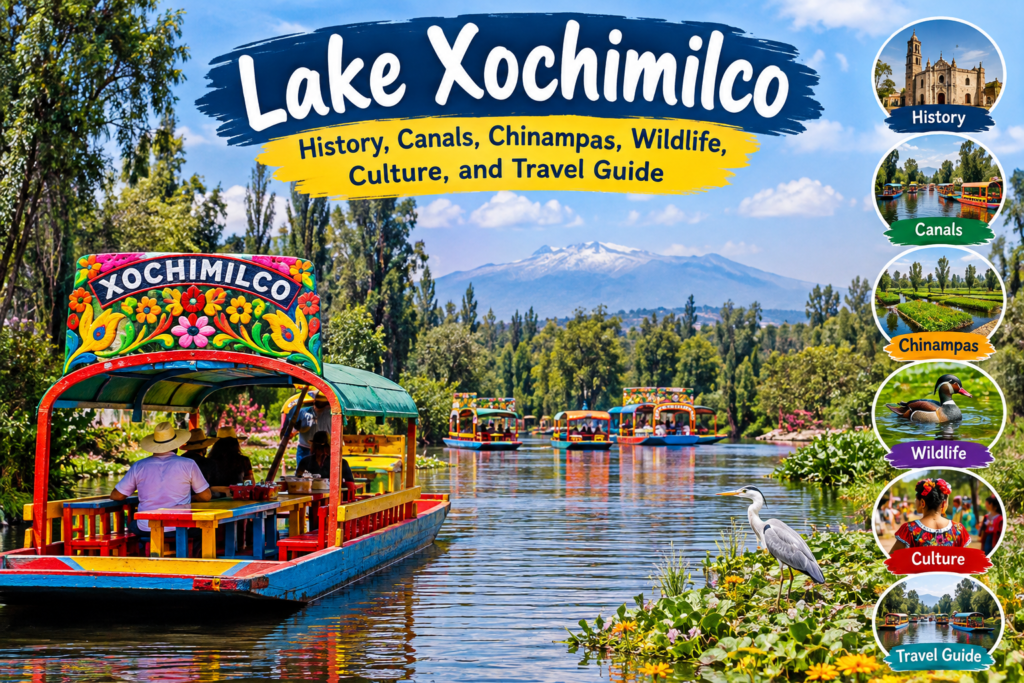

Lake Xochimilco is one of the most fascinating natural and cultural places in Mexico City. Although much of the original lake system has disappeared over the centuries, the remaining canals of Xochimilco still preserve an important part of the region’s ancient landscape. Colorful boats, floating gardens, historic waterways, local traditions, and unique wildlife make this area unlike many other places in the world.
Today, Lake Xochimilco is especially known for its traditional trajineras, which are brightly decorated flat-bottomed boats used to explore the canals. Visitors can enjoy a peaceful ride while seeing gardens, trees, historic farming areas, and local wildlife. At the same time, Xochimilco is much more than a tourist destination. It represents an ancient agricultural system, an important ecological area, and a living part of Mexican culture.
Understanding lake xochimilco requires looking beyond the famous boats. Its story includes Indigenous engineering, Spanish colonial changes, urban development, environmental challenges, conservation work, and the continuing efforts of local communities to protect this special landscape.
What Is Lake Xochimilco?
Lake Xochimilco was historically part of a large network of interconnected lakes and wetlands in the Valley of Mexico. These waters once covered a much greater area than the remaining waterways do today. Xochimilco was one of several important lake environments surrounding the ancient settlement of Tenochtitlan.
The name Xochimilco comes from Nahuatl and is commonly connected with the idea of a place where flowers are grown. This meaning fits the area’s long agricultural tradition, especially its famous chinampas, or raised farming plots.
Modern Xochimilco is located in the southern part of Mexico City. Instead of being a large open lake like the historical water body, the area is now best known for its surviving canals and wetland environment.
The remaining waterways are valuable because they provide a glimpse into what the ancient lake landscape may have looked like. They also support plants, animals, farming activities, and local traditions.
The Ancient History of Lake Xochimilco
The history of lake xochimilco goes back many centuries. Indigenous communities developed sophisticated ways to live and farm around the lakes of the Valley of Mexico.
The Xochimilca people were among the early groups associated with the region. They developed agricultural techniques that allowed communities to produce food in a wetland environment. Their knowledge became an important part of the cultural history of the area.
Before modern Mexico City expanded across the valley, the region contained several interconnected lakes. These included Lake Texcoco, Lake Xochimilco, Lake Chalco, and other bodies of water.
The lakes were not simply barriers to settlement. They were sources of food, transportation, water, and agricultural opportunities.
Communities learned how to use the landscape rather than completely fight against it. This relationship between people and water became one of the most important features of the region’s history.
The Chinampa Farming System
One of the most remarkable features connected with lake xochimilco is the chinampa system.
Chinampas are artificial agricultural islands or raised plots created in shallow wetland areas. Farmers built these plots using layers of vegetation, mud, and other natural materials. Trees and plants could help stabilize the edges.
The technique allowed farmers to cultivate crops in an environment where ordinary dry-land farming would’ve been difficult.
Chinampa agriculture became highly productive and supported communities with vegetables, flowers, herbs, and other crops.
Why Chinampas Were Important
The chinampa system had several advantages:
- It made productive use of wetland areas.
- It provided fertile soil for agriculture.
- Water was available close to the crops.
- Farmers could produce food throughout much of the year.
- Canals provided transportation between farming plots.
- The system created a close relationship between agriculture and aquatic ecosystems.
Even today, some farmers in Xochimilco continue traditional agricultural practices. That’s one reason the area is more than a historic attraction—it remains a living cultural landscape.
Lake Xochimilco and the Aztec World
Xochimilco became part of the wider political and economic world dominated by the Mexica, commonly known as the Aztecs. The lake system helped connect communities and supported trade.
The waterways provided routes for moving agricultural products and other goods. Canoes were essential forms of transportation because the landscape contained extensive areas of shallow water and canals.
The agricultural productivity of the southern lakes was especially valuable. Food produced in wetland farming areas could help support the growing population of the Valley of Mexico.
When Spanish forces arrived in the early sixteenth century, they encountered a complex civilization built around lakes, causeways, canals, and agricultural land.
The conquest dramatically changed the region. Over time, Spanish authorities and later governments modified the water system, beginning a long process that eventually transformed the Valley of Mexico.
How the Lake System Changed Over Time
The history of lake xochimilco is also a story of environmental transformation.
After the Spanish conquest, large-scale changes were made to the Valley of Mexico’s water system. Flood control became an important concern because Mexico City was repeatedly affected by flooding.
Canals and drainage projects gradually changed the relationship between the city and its lakes. Water was increasingly diverted or drained away.
As Mexico City expanded, the pressure on the remaining wetlands became greater.
Urban growth required roads, buildings, infrastructure, and additional water supplies. As a result, much of the original lake environment disappeared.
What remains around Xochimilco is therefore especially valuable. The canals and wetlands represent a surviving piece of an ecosystem that once covered a much larger portion of the valley.
The Famous Xochimilco Canals
Today, the canals are the heart of the Xochimilco experience.
Visitors often explore the waterways aboard trajineras, traditional flat-bottomed boats decorated with bright colors and names. Some boats carry flowers, while others feature decorative designs associated with families or special occasions.
A ride through the canals can feel very different from the busy streets of central Mexico City.
Instead of traffic and tall buildings, passengers see water, trees, gardens, farming plots, and other boats moving slowly through the canals.
The atmosphere can range from peaceful and quiet to lively and festive. On popular days, several boats may travel through the waterways at the same time.
What You May See on a Canal Ride
Depending on the route and season, visitors may encounter:
- Traditional trajineras
- Chinampa farming areas
- Flowers and plants
- Local birds
- Trees growing beside the canals
- Small bridges
- Floating food and music boats
- Local vendors
- Historic agricultural landscapes
For many travelers, the boat ride is the easiest way to appreciate how closely Xochimilco’s culture remains connected to water.
Trajineras: The Symbol of Xochimilco
The colorful trajinera has become one of the strongest symbols of Xochimilco.
Historically, similar boats were used for transportation and agriculture. Today, trajineras are closely connected with tourism and celebrations.
Many boats are decorated with colorful flowers, painted details, and names. Families and groups often rent them for birthdays, gatherings, celebrations, or relaxed outings.
A canal trip can be surprisingly social. Music may come from boats nearby, and some travelers bring food and drinks for their group.
Still, the boats aren’t merely entertainment. They are part of a much older tradition of transportation on the waterways.
That connection between history and modern life is what makes a visit especially interesting.
Wildlife Around Lake Xochimilco
The wetlands around lake xochimilco are important for biodiversity. Although urbanization has placed significant pressure on the ecosystem, the remaining canals and wetlands continue to provide habitat for many species.
One of the most famous animals associated with Xochimilco is the axolotl.
The axolotl is a remarkable aquatic salamander native to the Valley of Mexico. It has attracted international scientific interest because of its unusual biology and remarkable ability to regenerate certain body tissues.
Wild axolotl populations have declined severely, and conservation efforts are focused on protecting their remaining habitat.
Other organisms associated with the wetland environment include:
- Fish
- Frogs
- Aquatic insects
- Water plants
- Migratory and resident birds
- Small aquatic organisms
Protecting the canals isn’t only about preserving scenery. It also helps maintain habitat for species that depend on the wetland ecosystem.
The Axolotl and Conservation Efforts
The axolotl has become an important symbol of environmental conservation in Xochimilco.
Its survival depends heavily on suitable aquatic habitat. Pollution, habitat loss, invasive species, and changes in water conditions have created serious challenges.
Researchers, conservation groups, farmers, and local communities have worked on different approaches to improve habitat.
Some projects focus on restoring chinampa areas and creating cleaner, safer waterways. Other efforts involve breeding and research programs.
Conservation isn’t always simple, though. Xochimilco is both an ecological system and a densely populated urban area. People depend on the land and waterways, while wildlife needs healthy habitat.
Finding a balance between these needs is one of the major challenges facing the region.
Why Xochimilco Is Culturally Important
The importance of lake xochimilco goes far beyond geography.
Xochimilco preserves traditions connected with Indigenous history, farming, flowers, waterways, festivals, food, music, and community life.
Local celebrations can include religious traditions, family gatherings, and cultural events. The canals often become part of these occasions.
The area’s flower-growing tradition is also significant. Xochimilco has long been associated with horticulture, and plants remain an important part of its identity.
This combination of nature and culture gives Xochimilco a special character. It’s not simply a historical site frozen in the past. Instead, traditions continue to change while remaining connected to earlier generations.
UNESCO World Heritage Importance
Xochimilco is recognized internationally as part of a UNESCO World Heritage cultural site. The designation reflects the importance of the historic landscape and its relationship with Mexico City’s Indigenous and agricultural heritage.
The protected cultural landscape includes both the historic settlement and the agricultural systems associated with the chinampas.
This recognition highlights an important point: preserving Xochimilco isn’t only about saving old buildings or archaeological objects. The landscape itself is part of the heritage.
The canals, farming plots, vegetation, and traditional practices all contribute to the area’s cultural value.
Environmental Challenges Facing Lake Xochimilco
Despite its beauty and importance, lake xochimilco faces several environmental challenges.
Urban expansion is one of the biggest pressures. Mexico City is a huge metropolitan area, and development has reduced or changed natural wetland habitats.
Water quality is another concern. Pollution can affect plants, fish, amphibians, and other organisms.
Invasive species can also disturb the natural balance of the ecosystem. Some introduced animals compete with native species or change aquatic habitats.
Other challenges include:
| Environmental issue | Potential effect |
| Urban development | Loss of wetland habitat |
| Water pollution | Harm to aquatic life |
| Invasive species | Pressure on native wildlife |
| Water management | Changes to natural conditions |
| Habitat fragmentation | Reduced ecological connectivity |
| Decline of traditional farming | Loss of cultural landscape |
These challenges don’t mean that the future is hopeless. In fact, conservation programs and local initiatives show that restoration is possible when communities, scientists, farmers, and government organizations work together.
Sustainable Tourism in Xochimilco
Tourism provides income for local communities, but responsible tourism is important.
Visitors can help protect the area by treating the canals and surrounding environment with care.
Simple choices can make a difference:
- Avoid throwing waste into the water.
- Respect local farmers and residents.
- Follow rules provided by boat operators.
- Avoid disturbing wildlife.
- Support legitimate local businesses.
- Don’t damage plants or agricultural areas.
- Learn about the history of the area before visiting.
- Choose experiences that respect local communities.
In other words, visitors can enjoy Xochimilco without treating it like an ordinary amusement attraction.
The more people understand the cultural and environmental importance of the area, the easier it becomes to encourage respectful tourism.
What Makes Lake Xochimilco Different?
Many destinations have canals, boats, gardens, or historic neighborhoods. Xochimilco brings all of these elements together.
Its distinctive character comes from the combination of:
- Ancient Indigenous engineering
- Historic lake landscapes
- Traditional agriculture
- Surviving canals
- Colorful trajineras
- Local festivals
- Unique wildlife
- Modern urban life
- Conservation efforts
This mixture is difficult to reproduce anywhere else.
A visitor might begin the day surrounded by the enormous city of Mexico City and soon find themselves traveling through quiet waterways bordered by gardens and farming plots. That contrast is part of Xochimilco’s appeal.
Best Time to Experience Xochimilco
Xochimilco can be visited throughout much of the year, but the experience can vary depending on weather, holidays, weekends, and local events.
Weekends and holidays are generally more lively. Visitors looking for a calmer atmosphere may prefer less busy periods.
Weather can also affect the experience. Mexico City’s high elevation gives it a climate that can feel different from what travelers expect when they think of tropical Mexico.
Before visiting, it’s useful to check:
- Local weather
- Canal operating conditions
- Transportation options
- Opening schedules for attractions
- Current conservation or access rules
Planning ahead can make the experience smoother, especially during busy periods.
Things to Know Before Taking a Trajinera Ride
A canal ride is generally straightforward, but a little preparation helps.
Wear comfortable clothing and shoes because you’ll spend time on a boat and may walk around the area afterward.
Sun protection can also be useful. Even when the temperature feels comfortable, spending several hours outdoors can lead to sun exposure.
It’s also a good idea to carry water and keep personal belongings secure.
Most importantly, remember that the canals are part of a living community. Farmers, boat operators, residents, and conservation workers all have connections to this landscape.
A respectful visitor isn’t just enjoying a scenic ride—they’re entering a place with a long and continuing history.
Food, Music, and Local Life
One reason visitors remember Xochimilco is the atmosphere.
Food can be an important part of the experience. Depending on where you visit, you may find traditional Mexican dishes and snacks available around the canals and nearby neighborhoods.
Music is another familiar feature. Some boats may carry musicians who perform for visitors and groups.
For travelers, these experiences can create a festive atmosphere. But beyond tourism, they also reflect the social character of the area.
Xochimilco shows how food, music, family gatherings, agriculture, and waterways can remain connected in a modern city.
Lake Xochimilco as an Educational Destination
Lake xochimilco is also an excellent subject for students and researchers.
It can be studied from many different perspectives:
History
Students can explore Indigenous societies, the Aztec period, Spanish colonial changes, and the development of Mexico City.
Geography
The former lake system provides an example of how landscapes can change through natural processes and human engineering.
Agriculture
The chinampa system demonstrates an innovative approach to farming in wetland environments.
Biology
The axolotl and other organisms provide opportunities to study biodiversity, habitat loss, conservation, and ecological restoration.
Urban Planning
Xochimilco demonstrates the complicated relationship between a large city and its remaining natural ecosystems.
This combination makes the area valuable for both education and tourism.
How Technology Can Help Preserve Xochimilco
Modern technology can play a useful role in conservation.
Scientists can monitor water quality, map habitats, track wildlife, and study changes in vegetation.
Digital mapping can also help researchers understand how canals and agricultural plots are changing over time.
Technology isn’t a replacement for local knowledge, however. The experience of farmers and residents remains extremely valuable because they understand seasonal changes and everyday conditions in ways that satellite images alone can’t capture.
The strongest conservation strategies can combine scientific research with traditional knowledge.
The Future of Lake Xochimilco
The future of lake xochimilco depends on continued conservation and responsible management.
The region faces genuine challenges, but it also has important strengths. Local communities continue to maintain agricultural traditions, conservation programs are working to protect wildlife, and visitors remain interested in the area’s history and culture.
A successful future could involve:
- Stronger wetland protection
- Cleaner water
- Support for chinampa farmers
- Protection of native wildlife
- Responsible tourism
- Environmental education
- Restoration of damaged habitats
- Cooperation between local communities and researchers
Preservation doesn’t necessarily mean keeping everything exactly as it was. Instead, it means finding ways for cultural traditions, local livelihoods, wildlife, and modern city life to exist together.
Why Lake Xochimilco Still Matters Today
The story of Xochimilco offers an important lesson about the relationship between people and nature.
The ancient communities of the Valley of Mexico developed creative ways to farm and travel through wetlands. Centuries later, rapid urbanization transformed much of that environment. Yet parts of the old system survived.
That survival is meaningful.
Xochimilco reminds us that landscapes can carry history. A canal can be a transportation route, an agricultural resource, wildlife habitat, and cultural symbol at the same time.
It also shows that environmental protection and cultural preservation can support each other.
Frequently Asked Questions About Lake Xochimilco
Is Lake Xochimilco still a lake today?
The original Lake Xochimilco was part of a much larger historical lake system in the Valley of Mexico. Today, the most recognizable surviving parts are the canals and wetland areas of Xochimilco rather than a large open lake.
What is Xochimilco famous for?
Xochimilco is famous for its colorful trajineras, canals, chinampa agriculture, flowers, cultural traditions, and the axolotl.
What are chinampas?
Chinampas are raised agricultural plots traditionally created in shallow wetland environments. They were highly productive and became an important part of the agricultural history of the Valley of Mexico.
Can visitors ride boats in Xochimilco?
Yes. Visitors can generally experience the canals by riding traditional trajineras. Boat trips are one of the area’s most popular activities.
Why is the axolotl important to Xochimilco?
The axolotl is native to the Valley of Mexico and is strongly associated with Xochimilco. Its declining wild population has made habitat protection and conservation especially important.
Is Xochimilco only a tourist attraction?
No. Xochimilco is also a residential, agricultural, cultural, and ecological area. Tourism is only one part of its modern identity.
Why is Xochimilco important for history?
Xochimilco preserves elements of ancient Indigenous agricultural and water-management traditions. Its canals and chinampas provide a connection to the historic lake landscape of the Valley of Mexico.
Conclusion: The Continuing Story of Lake Xochimilco
Lake xochimilco represents far more than a collection of beautiful canals in southern Mexico City. It is a living connection between ancient Indigenous engineering, traditional agriculture, biodiversity, community life, and modern conservation.
Its colorful trajineras may be the first thing many visitors notice, but the deeper story lies beneath the surface. The canals are part of an old landscape shaped by people who learned how to farm, travel, and build communities around water. The chinampas demonstrate impressive agricultural knowledge, while the axolotl highlights the ecological importance of protecting the remaining wetlands.
At the same time, Xochimilco faces real environmental and urban pressures. Protecting its waterways requires cooperation, responsible tourism, scientific research, and support for the communities that continue to live and work there.
For anyone interested in Mexican history, nature, agriculture, culture, or sustainable tourism, lake xochimilco offers a fascinating example of how the past and present can exist side by side. Its future will depend on preserving both its natural environment and the human traditions that have made this remarkable landscape special for generations.
Stay connected with VoxTrend for the latest ideas, trends, updates & inspiring stories!