
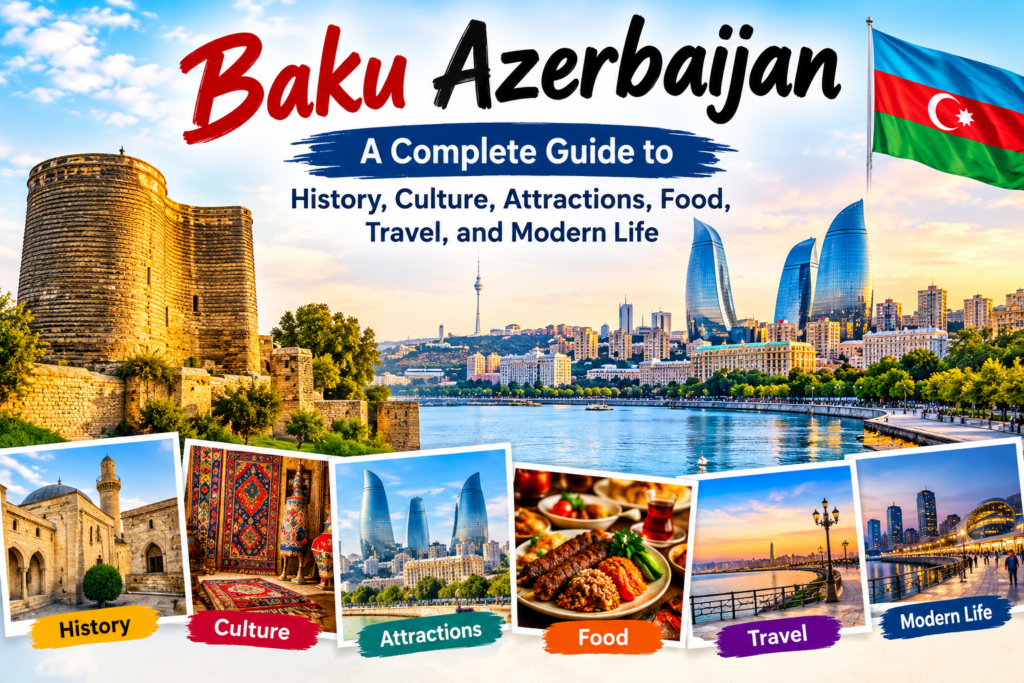

Baku Azerbaijan is the fascinating capital of Azerbaijan, a country located between Eastern Europe and Western Asia on the western shore of the Caspian Sea. Known for its historic old city, modern architecture, seaside boulevard, rich food culture, and deep connection with the oil industry, Baku offers a remarkable mix of old and new. One moment, you can be walking through narrow stone streets surrounded by centuries-old buildings; the next, you can be looking at striking modern towers rising above the city skyline.
Baku Azerbaijan has become an increasingly interesting destination for travelers who want something different from the usual European or Middle Eastern city break. Its location along the Caspian coast has helped shape its history, while centuries of trade have brought different cultures, ideas, and architectural influences to the city. Today, Baku is a major cultural, business, and tourism center.
Whether you’re interested in history, architecture, food, photography, shopping, or simply enjoying a coastal city, Baku has plenty to explore. This guide explains the city’s history, major attractions, culture, transportation, food, practical travel information, and reasons why Baku Azerbaijan deserves attention.
Baku Azerbaijan at a Glance
Before exploring the city in detail, it helps to understand a few basic facts about Baku.
| Feature | Information |
| Country | Azerbaijan |
| Capital | Baku |
| Location | Western shore of the Caspian Sea |
| Region | South Caucasus |
| Famous for | Old City, Flame Towers, Caspian coastline, oil history |
| Main historic area | Icherisheher |
| Currency | Azerbaijani manat |
| Official language | Azerbaijani |
| Major attractions | Maiden Tower, Palace of the Shirvanshahs, Flame Towers, Baku Boulevard |
| Popular food | Plov, dolma, kebabs, qutab, local pastries |
| Character | Historic, modern, coastal, cultural |
Baku is also Azerbaijan’s largest city and an important center for business, education, culture, and transportation. Its coastal position gives the city a distinctive atmosphere, particularly around the Caspian waterfront.
The History of Baku Azerbaijan
The story of Baku Azerbaijan goes back many centuries. The city’s location made it important because it stood near major routes connecting different parts of the Caucasus and the Caspian region. Traders, travelers, rulers, and armies passed through the wider region over many generations.
One of the most important historic areas is Icherisheher, also called the Old City. Surrounded by defensive walls, this part of Baku contains buildings and streets that reflect the city’s medieval heritage. The Old City remains one of the most recognizable parts of Baku.
Baku’s history also became closely connected with petroleum. Natural oil and gas resources existed in the region for centuries, and the development of the modern oil industry transformed the city dramatically during the nineteenth and early twentieth centuries.
As the oil industry expanded, Baku attracted workers, investors, architects, and entrepreneurs from different parts of the world. New buildings appeared alongside older structures, creating an architectural mixture that remains visible today.
The twentieth century brought further political and social changes. Baku became part of the Soviet Union and later became the capital of an independent Azerbaijan after the country’s independence in 1991.
Today, the city continues to develop while preserving important parts of its historic identity.
Icherisheher: The Historic Heart of Baku
If you’re visiting Baku Azerbaijan, Icherisheher should be high on your travel list. Its name means “Inner City,” and it represents the historic core of Baku.
Walking through Icherisheher feels very different from walking through the city’s modern districts. Narrow streets, stone walls, traditional architecture, small courtyards, and historic buildings create a unique atmosphere.
The area contains several major landmarks, including:
- Maiden Tower
- Palace of the Shirvanshahs
- Historic city walls
- Old mosques
- Traditional houses
- Small museums and cultural spaces
- Local shops and restaurants
It’s easy to spend several hours exploring the Old City without following a strict schedule. In fact, wandering through its streets is part of the experience.
The historic center also demonstrates how Baku has developed over time. Medieval architecture stands close to buildings from later periods, showing the city’s changing identity.
Maiden Tower and Its Legends
The Maiden Tower is one of the most famous landmarks associated with Baku Azerbaijan. Standing inside the Old City, this unusual stone structure has become one of the city’s best-known symbols.
Its exact original purpose has been debated by historians, and several theories have been suggested. Some interpretations connect it with defensive functions, while others propose religious, astronomical, or other historical roles.
The tower is also connected with local legends. One popular story involves a young woman and a ruler, although different versions of the tale exist.
Beyond the legends, the tower is important because it represents the mystery and historical depth of Baku. Visitors can explore the structure and learn about the city’s past while enjoying views over parts of the Old City and surrounding area.
Palace of the Shirvanshahs
Another major historical attraction in Baku is the Palace of the Shirvanshahs. This medieval complex was associated with the Shirvanshah dynasty, which ruled parts of the region for centuries.
The complex includes several architectural elements, such as:
- Palace buildings
- A mosque
- Mausoleum
- Courtyards
- Defensive features
- Historic stone structures
The architecture provides an opportunity to understand the political and cultural importance of medieval Baku.
For travelers interested in history, the palace offers more than beautiful stonework. It helps explain the role Baku played within the wider Shirvan region.
Flame Towers and Modern Baku
While the Old City represents historic Baku, the Flame Towers represent its modern image.
These three distinctive skyscrapers rise above the city and have become one of Baku’s most recognizable contemporary landmarks. Their design is associated with flames, reflecting Azerbaijan’s long relationship with fire and petroleum.
The towers are particularly impressive when illuminated after dark. From different parts of the city, visitors can see the towers rising above the surrounding buildings.
This contrast is one of the things that makes Baku Azerbaijan interesting. Medieval stone architecture and modern skyscrapers aren’t separated into completely different worlds. Instead, they form part of the same urban landscape.
Baku Boulevard and the Caspian Sea
Baku’s relationship with the Caspian Sea is central to its identity.
Baku Boulevard stretches along the waterfront and provides an enjoyable place to walk, relax, take photographs, and experience the city’s coastal atmosphere. The area has developed into an important recreational and public space.
A walk along the waterfront can include views of:
- The Caspian Sea
- Modern buildings
- Parks and gardens
- Cultural attractions
- Restaurants and cafés
- Contemporary public spaces
At sunset, the waterfront can become especially attractive. The changing light over the Caspian creates excellent opportunities for photography.
The boulevard also shows a different side of Baku. Instead of focusing on ancient history or business, it provides space for recreation and everyday city life.
Heydar Aliyev Center and Contemporary Architecture
The Heydar Aliyev Center is another major architectural attraction in Baku Azerbaijan. Designed by architect Zaha Hadid, the building is known for its flowing curves and unusual form.
Unlike traditional stone buildings in the Old City, the center has a futuristic appearance. Its smooth exterior creates a strong contrast with the more traditional architecture found elsewhere in Baku.
Inside, visitors can find exhibitions and cultural programs depending on the schedule.
The building is also popular among photographers because its unusual shape creates interesting perspectives from different angles. Even travelers who aren’t especially interested in architecture may find the structure memorable.
Baku Azerbaijan and Its Oil Heritage
Oil has played a major role in Baku’s development. The region has long been associated with naturally occurring petroleum and gas, and the large-scale oil industry changed Baku’s economy and physical appearance.
During the nineteenth century, Baku became one of the world’s important oil-producing centers. Wealth generated by the industry contributed to the construction of impressive buildings, businesses, and infrastructure.
The city’s oil heritage can still be seen in:
- Historic industrial areas
- Older mansions
- Oil-related museums and exhibitions
- Architectural landmarks
- Modern energy infrastructure
Understanding this history adds another layer to a visit. Baku isn’t simply a city with modern skyscrapers; its modern identity is strongly connected to the resources beneath and around the region.
Azerbaijani Culture and Daily Life
Azerbaijan has a culture influenced by its location between different regions. Turkish, Persian, Caucasian, Russian, and broader Eurasian influences can be found in various aspects of Azerbaijani life.
Baku reflects this cultural mixture.
Music, food, architecture, hospitality, and traditional celebrations all contribute to the city’s identity. Visitors may notice that family and social gatherings remain important parts of everyday life.
Azerbaijani hospitality is also well known. Guests are often welcomed warmly, especially when visiting local homes or traditional restaurants.
The city itself is modern and cosmopolitan, but traditional customs remain visible. This combination gives Baku a character that can feel both familiar and surprising to international visitors.
Food to Try in Baku Azerbaijan
Food is an important part of experiencing Baku Azerbaijan. Azerbaijani cuisine includes rice dishes, grilled meats, vegetables, herbs, dairy products, soups, pastries, and many regional specialties.
Some foods worth trying include:
Plov
Plov is a famous rice-based dish found across Azerbaijan and neighboring regions. Different versions may include meat, dried fruits, nuts, vegetables, or other ingredients.
Dolma
Dolma usually involves vegetables or leaves filled with a mixture that may contain meat, rice, herbs, and spices. Recipes vary between regions and families.
Qutab
Qutab is a thin filled flatbread. Depending on the recipe, it can contain herbs, meat, pumpkin, cheese, or other fillings.
Kebabs
Grilled meat is popular throughout Azerbaijan. Restaurants may serve different types of kebabs using lamb, beef, chicken, or vegetables.
Local Sweets
Tea and sweets are also important parts of Azerbaijani food culture. Baklava-style pastries and other regional desserts can be found in traditional cafés and shops.
Trying local food is a simple way to experience the city beyond its landmarks.
Shopping in Baku
Baku offers a mixture of modern shopping centers, traditional markets, souvenir shops, and independent stores.
Travelers looking for souvenirs might consider:
- Traditional carpets
- Handmade crafts
- Local tea
- Sweets
- Spices
- Decorative items
- Traditional clothing or textiles
- Azerbaijan-themed gifts
Carpets have a particularly important place in Azerbaijani culture. If you’re interested in purchasing one, it’s worth learning about quality, origin, materials, and authenticity before making a significant purchase.
Modern shopping centers provide a completely different experience, with international brands, restaurants, entertainment, and contemporary retail spaces.
Things to Do in Baku Azerbaijan
There are plenty of ways to experience the city, whether you’re visiting for a short break or staying longer.
Some popular activities include:
- Explore Icherisheher
- Visit Maiden Tower
- See the Palace of the Shirvanshahs
- Walk along Baku Boulevard
- Photograph the Flame Towers
- Visit the Heydar Aliyev Center
- Explore museums
- Try Azerbaijani cuisine
- Enjoy traditional tea
- Shop for local souvenirs
- Explore the city’s architecture
- Watch the sunset near the Caspian waterfront
- Take a day trip outside the capital
One useful approach is to combine historic and modern attractions on the same day. For example, you might explore the Old City in the morning and visit a modern cultural center later.
Best Time to Visit Baku Azerbaijan
The best time to visit Baku depends on what you want to do.
Spring can be pleasant for sightseeing because temperatures are generally comfortable and outdoor activities become enjoyable.
Summer can be warm and sometimes windy. The Caspian waterfront can provide a pleasant change, but travelers should still prepare for strong sunlight and heat.
Autumn is another attractive period for exploring the city. Comfortable weather can make walking tours easier.
Winter is cooler and can be windy. However, the city remains active, and indoor attractions such as museums, cultural centers, cafés, and shopping areas can still provide plenty to do.
Because Baku is known for its winds, visitors should remember that conditions can sometimes feel different from what the temperature alone suggests.
Getting Around Baku
Baku has several transportation options, making it possible to explore the city without relying entirely on a private vehicle.
Metro
The Baku Metro is useful for reaching different parts of the city. It can be especially convenient for travelers staying away from the central historic area.
Buses
City buses connect many neighborhoods and major destinations. Routes and schedules should be checked using current local information.
Taxis and Ride Services
Taxis can be convenient, especially when traveling with luggage or visiting destinations outside the main tourist center.
Walking
Walking is one of the best ways to experience central Baku. The Old City, waterfront, and several major attractions can be explored on foot.
A combination of walking and public transportation often works well for visitors.
Day Trips From Baku
Although Baku Azerbaijan has plenty to offer, the surrounding region provides additional experiences.
Popular destinations and attractions in the wider area include:
- Gobustan
- Mud volcano regions
- Ateshgah Fire Temple
- Yanar Dag
- Absheron Peninsula
- Mountain areas farther from Baku
Gobustan is particularly interesting for travelers who enjoy archaeology and ancient rock art. The Absheron Peninsula also provides opportunities to learn more about the region’s natural and cultural history.
A day trip can help visitors understand that Azerbaijan is much larger and more diverse than its capital.
Baku’s Climate and What to Pack
Baku has a semi-arid climate, and wind is an important feature of the city’s weather.
What you pack should depend on the season, but useful items can include:
- Comfortable walking shoes
- Lightweight clothing for warmer months
- A light jacket for windy evenings
- Sun protection
- Sunglasses
- A reusable water bottle
- Weather-appropriate layers
Comfortable shoes are especially useful because historic areas are often best explored by walking.
Where to Stay in Baku Azerbaijan
Accommodation in Baku ranges from luxury hotels to mid-range properties, boutique hotels, guesthouses, and apartments.
The best location depends on your priorities.
Old City area: Convenient for travelers who want to stay close to historic attractions.
City center: Useful for visitors interested in restaurants, shopping, business districts, and modern attractions.
Waterfront area: Suitable for travelers who enjoy seaside walks and views.
Areas outside the central district: These can sometimes provide quieter surroundings and different accommodation choices.
When choosing accommodation, consider distance from major attractions, public transportation, restaurants, and the type of atmosphere you prefer.
Is Baku Azerbaijan Good for Families?
Baku can be an interesting destination for families because it offers a mixture of educational, cultural, outdoor, and entertainment activities.
Families can explore historical sites, walk along the waterfront, visit museums, enjoy parks, and discover local food.
However, parents should consider walking distances, weather conditions, and children’s interests when planning each day.
A flexible itinerary usually works better than trying to visit every attraction. After all, travel is more enjoyable when there’s enough time to rest and enjoy the surroundings.
Baku Azerbaijan for Photography Lovers
Baku provides many different photography opportunities.
Historic architecture offers detailed stonework, narrow streets, arches, and traditional designs. Modern Baku provides skyscrapers, futuristic buildings, wide avenues, and dramatic city views.
Popular photography subjects include:
- Maiden Tower
- Old City walls
- Flame Towers
- Heydar Aliyev Center
- Baku Boulevard
- Caspian Sea
- Historic mansions
- City streets at night
Sunrise and sunset can produce particularly interesting light. At night, modern buildings and illuminated landmarks create an entirely different appearance.
Practical Travel Tips
A little preparation can make a trip to Baku much easier.
Keep these points in mind:
- Carry some local currency for smaller purchases.
- Keep important travel documents secure.
- Wear comfortable shoes for walking.
- Check attraction opening times before visiting.
- Respect local customs and religious sites.
- Learn a few basic Azerbaijani words if possible.
- Keep hydrated during warm weather.
- Be prepared for wind near the Caspian coast.
- Use reputable transportation services.
- Keep an eye on your belongings in busy areas.
It’s also useful to remember that travel information can change. Visa requirements, transportation schedules, attraction hours, and entry rules should always be checked through current official sources before departure.
Why Baku Feels Different From Other Capitals
Baku has an unusual visual identity. Many capitals have a clear architectural style, but Baku combines several periods in a relatively compact area.
You might see:
- Medieval defensive walls
- Islamic architectural elements
- European-style nineteenth-century buildings
- Soviet-era structures
- Contemporary skyscrapers
- Futuristic cultural buildings
This mixture isn’t accidental. It reflects the city’s long history and changing economic importance.
The Caspian Sea adds another layer. Baku isn’t simply a historic inland capital; its waterfront has always influenced its identity and economy.
A Simple Baku Azerbaijan Itinerary
For a first visit, a flexible itinerary could look like this.
First Day
Focus on the historic center.
Explore Icherisheher, Maiden Tower, the Palace of the Shirvanshahs, old streets, and traditional restaurants.
Second Day
Explore modern Baku.
Visit the Heydar Aliyev Center, see the Flame Towers, explore museums, and spend time around the city’s modern districts.
Third Day
Enjoy the waterfront and surrounding attractions.
Walk along Baku Boulevard, visit additional museums or cultural sites, and consider an excursion toward Gobustan or another nearby attraction.
The exact schedule should be adjusted according to weather, opening times, personal interests, and available transportation.
Frequently Asked Questions About Baku Azerbaijan
What is Baku Azerbaijan famous for?
Baku Azerbaijan is famous for its historic Old City, Maiden Tower, Palace of the Shirvanshahs, Flame Towers, Caspian Sea waterfront, oil heritage, modern architecture, and Azerbaijani cuisine.
Is Baku a modern city?
Yes. Baku combines historic neighborhoods with modern infrastructure, contemporary architecture, shopping centers, hotels, cultural institutions, and business districts.
Is Baku on the Caspian Sea?
Yes. Baku is located on the western shore of the Caspian Sea, and the coastline is an important part of the city’s identity.
What food should visitors try in Baku?
Visitors can try dishes such as plov, dolma, qutab, kebabs, local pastries, and Azerbaijani tea.
How many days are enough for Baku?
A few days can provide a good introduction to the city. A longer stay allows travelers to explore museums, neighborhoods, restaurants, and attractions outside the central area.
What is the Old City of Baku called?
The historic center is called Icherisheher, meaning “Inner City.” It is one of the most important historic areas in Baku.
Is Baku good for photography?
Yes. The combination of medieval architecture, modern skyscrapers, waterfront scenery, and distinctive buildings creates many photography opportunities.
Final Thoughts on Baku Azerbaijan
Baku Azerbaijan is a city where history and modern life exist side by side. Its ancient walls and medieval landmarks tell the story of earlier generations, while its modern skyline reflects the city’s economic growth and changing identity. Add the Caspian Sea, Azerbaijani cuisine, local traditions, museums, shopping areas, and surrounding attractions, and there’s plenty for curious travelers to discover.
What makes Baku especially memorable is its contrast. You can explore a centuries-old street in Icherisheher and later watch the lights of modern towers across the city. You can enjoy traditional Azerbaijani food, stroll beside the Caspian Sea, and then visit a futuristic cultural building. In short, baku azerbaijan offers a varied travel experience for people who enjoy history, culture, architecture, food, and modern city life.
Stay connected with VoxTrend for the latest ideas, trends, updates & inspiring stories!