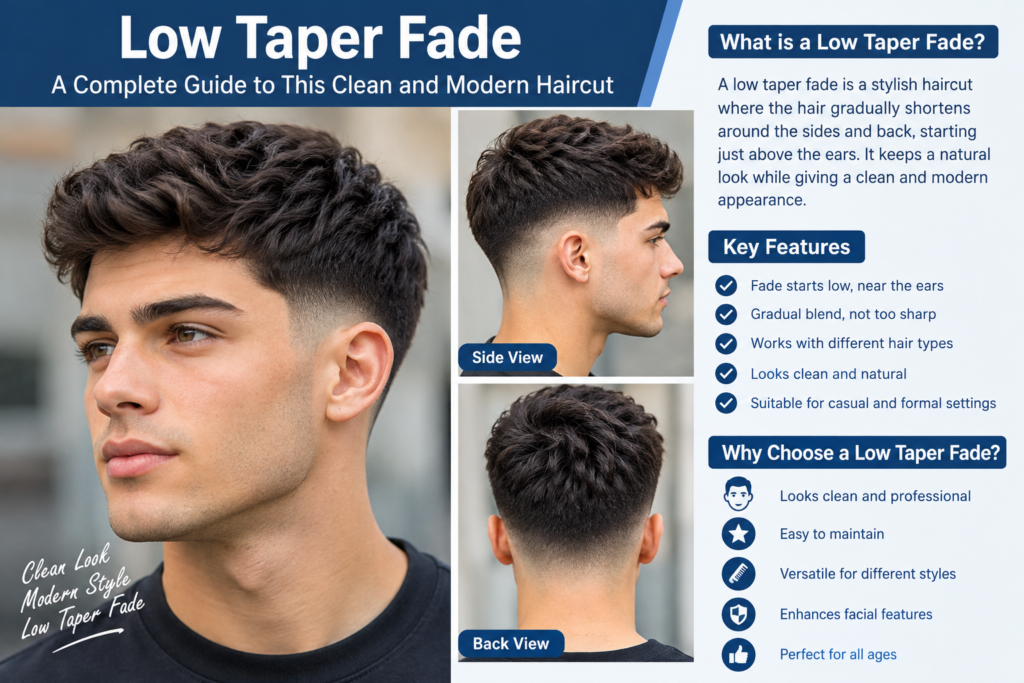

A low taper fade is one of the most popular modern hairstyles for people who want a clean, stylish, and easy-to-manage look. Unlike some dramatic fades that remove a large amount of hair from the sides, a low taper fade keeps the change subtle and begins close to the ears and neckline. The result is neat without looking too sharp or extreme.
What makes the low taper fade special is its flexibility. It can work with short hair, medium-length hair, curls, waves, textured hair, straight hair, and many different face shapes. You can also combine it with a textured crop, side part, curly top, slicked-back style, or even longer hair on top. In other words, there’s plenty of room to make the haircut your own.
For someone visiting a barber for the first time, the terminology can seem confusing. Taper, fade, low fade, mid fade, and high fade may sound similar, but they create different results. Understanding these differences can help you explain exactly what you want and avoid an unwanted haircut.
What Is a Low Taper Fade?
A low taper fade is a haircut where the hair gradually becomes shorter around the lower sides of the head and the neckline. The taper usually starts around the area near the ears and continues toward the back of the neck. The hair isn’t suddenly cut from long to very short. Instead, the barber creates a smooth transition between different lengths.
The word “low” is important. It means the fading effect stays close to the bottom part of the head. This gives the style a more natural appearance compared with a high fade, where the shorter section reaches much higher toward the temples.
A skilled barber uses clippers, guards, and sometimes scissors to create the transition. The goal is to remove harsh lines and create a gradual blend. When done properly, the haircut looks clean from the front, sides, and back.
The low taper fade is also popular because it doesn’t completely change the overall shape of the hairstyle. You can keep plenty of length on top while enjoying a tidy finish around the edges.
Why Is the Low Taper Fade So Popular?
The popularity of the low taper fade comes from its balance between traditional grooming and modern style. It looks fashionable without being overly dramatic, which makes it suitable for many different situations.
For example, someone might wear this haircut at school, work, a family event, or a casual gathering. The same haircut can look relaxed when the top is naturally textured and more polished when the hair is styled neatly.
Another reason people like it is that the haircut works with many hair types. Straight hair can have a clean textured top, while curly hair can be left longer to show its natural pattern. Wavy hair can also benefit from the contrast between the textured top and cleaner sides.
Here are some key benefits:
- Clean and polished appearance
- Subtle transition around the sides
- Works with many hair textures
- Easy to customize
- Suitable for different face shapes
- Can be combined with many hairstyles
- Usually easier to maintain than more complicated cuts
- Looks good with both casual and formal clothing
So, if you want something stylish but not too flashy, the low taper fade is certainly worth considering.
Low Taper Fade vs. Low Fade
Although the names sound similar, a low taper fade and a traditional low fade aren’t exactly the same. The biggest difference is how much of the sides and back are faded.
A low fade generally creates a visible fade across a larger section of the lower sides. The hair gradually becomes shorter as it moves downward, often creating a stronger contrast between the upper hair and the faded section.
A low taper fade, on the other hand, focuses more closely on the edges around the ears, temples, and neckline. More of the natural hair remains on the sides. Because of this, the taper often looks softer and more conservative.
The choice depends on the appearance you prefer. If you want a stronger, more noticeable transition, a low fade may suit you. If you’d rather keep the haircut natural and understated, the low taper fade may be the better option.
Low Taper Fade vs. Mid Fade and High Fade
The position of the fade is one of the easiest ways to understand different fade styles. A low fade starts near the bottom of the sides, while a mid fade begins higher. A high fade starts even closer to the upper sides of the head.
A high fade can create a bold and sharp appearance because more hair is removed from the sides. A mid fade offers a middle ground between a high and low fade.
The low taper fade is usually the most subtle of these choices. That’s why it can be a great starting point for someone who doesn’t want a dramatic change.
| Haircut Style | Fade Position | Overall Appearance | Maintenance |
| Low Taper Fade | Near ears and neckline | Subtle and clean | Moderate |
| Low Fade | Lower sides | Clean with more contrast | Moderate |
| Mid Fade | Middle sides | Noticeable and balanced | Moderate |
| High Fade | Upper sides | Bold and dramatic | Higher |
| Skin Fade | Very short to skin | Sharp and strong | Higher |
Remember, there isn’t one haircut that’s best for everyone. Your hair texture, preferred length, lifestyle, and personal taste all matter.
Best Hair Types for a Low Taper Fade
One of the great things about a low taper fade is its versatility. It can be adapted to almost any hair type when the barber understands how the hair behaves.
Straight hair can be styled in many ways. A textured top can create a relaxed appearance, while a side part can make the haircut look more traditional.
Wavy hair can add natural movement to the style. Instead of fighting the waves, a barber can leave enough length on top so the natural texture becomes part of the haircut.
Curly hair can look especially striking with a low taper because the clean sides create contrast with the curls on top. The curls remain the main feature while the taper keeps the edges tidy.
Thick hair can also benefit from the haircut because removing some bulk around the lower sides can make the overall shape easier to manage.
Fine hair may require a different approach. Rather than removing too much hair, a barber may use texture and careful shaping to create the appearance of fullness.
Popular Low Taper Fade Styles
There isn’t just one version of this haircut. In fact, the low taper fade can be combined with many different hairstyles.
Low Taper Fade With Textured Top
This combination gives the haircut a youthful and relaxed appearance. The top is kept longer and styled with natural texture, while the sides and neckline stay neat.
It’s a good option if you don’t want your hair to look overly formal. A small amount of styling product can help define the texture without making the hair look heavy.
Low Taper Fade With Curly Hair
People with curls can keep their natural texture on top while using the taper to create a clean outline. The result is a strong contrast without removing the character of the curls.
The key is not to make the sides too short if you want a softer appearance. Your barber can adjust the taper based on how tightly your hair curls.
Low Taper Fade With Side Part
A side part adds a classic touch to the haircut. The clean taper around the lower sides keeps the hairstyle modern, while the part gives it a more traditional finish.
This style can work particularly well for occasions where you want to look neat and well-groomed.
Low Taper Fade With Fringe
A fringe can give the haircut a more relaxed and youthful feel. The top can be left slightly longer and brought forward, while the taper provides structure around the sides.
The length of the fringe should depend on your hair texture and how you normally style it.
Low Taper Fade With Slicked-Back Hair
If you prefer a polished look, longer hair on top can be brushed backward. The taper creates a clean foundation without taking attention away from the longer top.
This option usually requires more styling than a textured haircut, but the finished appearance can be very refined.
How to Ask Your Barber for a Low Taper Fade
Knowing what to say at the barber shop can make a big difference. Instead of simply saying, “Give me a fade,” explain where you want the fade to begin and how much length you want to keep.
You could say that you want a low taper fade around the ears and neckline, while keeping the sides relatively full. Then explain how you want the top shaped.
It also helps to tell your barber:
- How much length you want on top
- Whether you want the sides blended or left fuller
- Whether you want a natural or sharp neckline
- Whether you want a line-up around the forehead
- How you normally style your hair
- Whether you want to keep your natural curls or waves
A reference photo can also help. Haircuts can be described differently from one barber to another, so a clear photo gives both of you a better idea of the desired result.
Most importantly, don’t be afraid to ask questions. A professional barber should be able to explain what will work with your hair and suggest adjustments when needed.
Choosing the Right Low Taper Fade for Your Face Shape
Face shape can influence how a haircut looks, although it shouldn’t be treated as a strict rule. Personal preference matters just as much.
For a rounder face, keeping some height or texture on top can create a more balanced appearance. A clean low taper fade can help keep the sides controlled without making the haircut look too wide.
For an oval face, many variations can work because this face shape tends to be quite flexible with different hairstyles.
For a square face, a textured top or slightly longer style can complement the natural structure of the face. The low taper keeps the edges tidy while allowing the top to remain the main feature.
For a longer face, excessive height on top may not be necessary. Keeping a little more width through the hairstyle can create a balanced look.
These are simply styling guidelines. A good barber will consider your actual hair growth, texture, and head shape rather than following a generic formula.
How to Maintain a Low Taper Fade
A low taper fade can look excellent when fresh, but like most short hairstyles, it eventually grows out. The edges around the ears and neckline are usually the first areas where the haircut begins to lose its sharp appearance.
How often you visit the barber depends on how quickly your hair grows and how precise you want the haircut to remain.
Between barber visits, basic grooming can help. Keep the hair clean, use a suitable shampoo, and avoid using excessive styling products. If you have curly or textured hair, choose products designed for your hair type rather than trying to force it into a completely different texture.
If you’re styling the top, start with a small amount of product. You can always add more, but using too much can make the hair appear heavy or greasy.
A simple routine might include:
- Washing the hair according to its needs
- Gently drying rather than aggressively rubbing
- Brushing or shaping the top as desired
- Using a small amount of suitable styling product
- Keeping the neckline and edges tidy
- Returning to the barber when the taper loses its shape
The low taper fade is relatively practical, but regular grooming still makes a noticeable difference.
Common Mistakes to Avoid
Even a great haircut can go wrong when the communication between the customer and barber isn’t clear. One common mistake is asking for a fade without explaining where you want it to start.
Another mistake is choosing a haircut based only on a photograph of someone with completely different hair. A style that works perfectly on thick straight hair may need adjustment for fine, curly, or wavy hair.
It’s also easy to request sides that are too short simply because a fresh fade looks impressive in a photograph. If you’re unsure, starting with a more conservative low taper fade gives you room to make changes later.
Avoid trying to judge the haircut only from one angle. Ask your barber to show you the sides and back when possible. That way, you can make sure the shape matches what you expected.
Finally, don’t overload your hair with styling products. A good haircut should do most of the work. As the saying goes, less can sometimes be more.
Low Taper Fade for Different Personal Styles
A major advantage of the low taper fade is that it can fit different personalities and fashion choices. Someone who prefers simple clothing can pair it with a natural textured top, while someone who enjoys a sharper appearance might choose a defined part or carefully styled top.
The haircut can also move between casual and formal settings. That’s a big reason it has become such a dependable choice.
For a relaxed look, allow the top to follow its natural texture. For a cleaner appearance, brush or comb the top into shape. If your hair is curly, defining the curls can create a neat but natural finish.
You don’t need to copy a celebrity or social media trend to make the haircut work. In fact, the best result is usually one that suits your own hair and daily routine.
Is a Low Taper Fade Easy to Style?
Generally, yes. The amount of styling required depends mostly on the length and texture of the hair on top.
If the top is short, you may need little more than brushing it into place. A textured style can also be quite simple because the goal is often to create a natural, slightly messy appearance.
Longer hair requires more attention. You might need a comb, brush, blow dryer, or styling product to achieve the desired shape.
Curly hair can require a different routine. Instead of brushing the curls aggressively, you may want to use products that support the natural curl pattern.
The important point is that the taper itself doesn’t usually require complicated daily styling. Most of the styling work happens on the top.
How to Make Your Low Taper Fade Look Better
The best haircut isn’t only about the cut. Overall grooming plays a role, too.
Keeping the hair healthy can improve how the haircut looks. Gentle washing, appropriate conditioning, and avoiding excessive heat can help maintain the natural appearance of the hair.
Your barber can also adjust the haircut over time. Maybe you discover that you prefer a slightly longer top or a softer neckline. Those small changes can make the style feel much more personal.
Another useful approach is to think about your daily routine. If you don’t want to spend much time styling your hair every morning, choose a top length and texture that naturally falls into place.
A practical haircut that suits your lifestyle is usually more satisfying than a complicated style that requires constant work.
Frequently Asked Questions About Low Taper Fade
What is a low taper fade?
A low taper fade is a hairstyle where the hair gradually becomes shorter around the lower sides, ears, and neckline. The transition stays relatively low, creating a subtle and clean appearance.
Is a low taper fade good for curly hair?
Yes. A low taper fade can work very well with curly hair. The taper cleans up the edges while allowing the natural curls on top to remain the main feature.
How is a low taper different from a high fade?
A low taper keeps the shorter transition close to the ears and neckline. A high fade begins much higher on the sides, creating a stronger and more noticeable contrast.
Can a low taper fade work with long hair?
Yes. Keeping more length on top can create an attractive contrast with the shorter tapered areas. The longer top can be textured, brushed back, parted, or styled naturally.
Is a low taper fade suitable for school or work?
In many settings, yes. Its relatively subtle appearance makes it a versatile choice. However, individual school or workplace grooming rules can vary.
How often should a low taper fade be refreshed?
There isn’t one fixed schedule. Hair growth differs from person to person. Some people prefer frequent barber visits for a very fresh appearance, while others allow the taper to grow out naturally.
Should I bring a picture to my barber?
Absolutely. A reference photo can make communication easier. You should also explain what you like about the picture because your barber may need to adapt the style to your own hair.
Final Thoughts on Low Taper Fade
The low taper fade has earned its popularity because it combines simplicity, flexibility, and modern style. It doesn’t force you into one specific look. Instead, it gives you a clean foundation that can be paired with curls, waves, straight hair, textured tops, fringes, side parts, and many other hairstyles.
Another strong advantage is its subtle nature. While some fades create a dramatic transformation, the low taper fade keeps the transition closer to the lower sides and neckline. That makes it a practical choice for people who want something fashionable without going too extreme.
Before getting the haircut, think about your hair texture, preferred top length, daily routine, and how much maintenance you’re comfortable with. Communicate clearly with your barber, and don’t hesitate to ask for adjustments based on your natural hair.
At the end of the day, the best low taper fade is one that fits you—not simply one that looks good in a photograph. With the right cut and basic grooming routine, this timeless modern style can remain clean, comfortable, and confident-looking as it grows.
Stay connected with VoxTrend for the latest ideas, trends, updates & inspiring stories!