
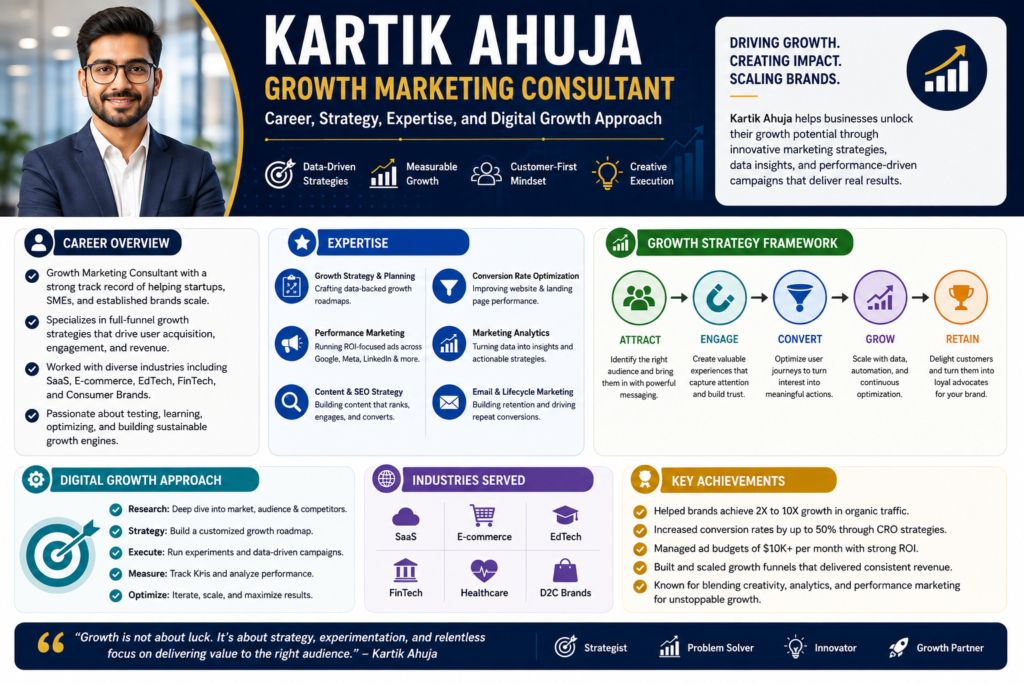

kartik ahuja growth marketing consultant is a search phrase associated with a modern, systems-focused approach to digital marketing, business growth, customer acquisition, and scalable online operations. Public information connects Kartik Ahuja with entrepreneurship, growth marketing, marketing strategy, automation, funnels, and GrowthScribe. His own company biography says his professional journey began in sales in 2011 before he moved deeper into marketing and business building.
What makes the topic interesting is that growth marketing isn’t simply about running advertisements or increasing website traffic. Done properly, it looks at the whole customer journey, from the first interaction with a brand to conversion, retention, referrals, and revenue. Public material associated with Ahuja emphasizes this broader, systems-based view rather than treating marketing as a collection of disconnected campaigns.
This article explores his professional background, growth marketing philosophy, strategies, frameworks, strengths, limitations, and the lessons businesses can take from this approach. Because some online claims about individual marketers can be difficult to verify, the discussion below separates publicly documented information from general observations about the growth-marketing model.
Who Is Kartik Ahuja?
Kartik Ahuja is publicly described as an entrepreneur and growth marketing professional associated with GrowthScribe. His company identifies him as its founder, while an Entrepreneur author profile describes him as a tech entrepreneur and growth marketing expert working across startup growth, scalable marketing, and financial strategy.
His professional story reportedly began in sales in 2011. According to his company’s biography, his early experience involved selling consumer products and trying to understand why some marketing investments produced better results than others. That experience helped shape his later focus on understanding businesses at a deeper level rather than relying on attractive campaigns alone.
His public professional positioning includes areas such as:
- Growth marketing
- Marketing strategy
- Lead generation
- Funnel development
- Conversion optimization
- Digital marketing
- Automation
- Business growth
- Scalable marketing systems
This combination is important because a growth consultant often works across several departments rather than operating only as an advertising specialist.
What Does a Growth Marketing Consultant Do?
Before discussing kartik ahuja growth marketing consultant, it’s useful to understand what the term “growth marketing consultant” actually means.
A traditional marketing campaign might have a clear beginning and end. A growth marketing process is usually more continuous. It asks what is working, what isn’t, why customers behave in certain ways, and where the business can improve.
A growth marketing consultant may examine areas such as:
| Area | Main Question |
| Audience | Who is the ideal customer? |
| Positioning | Why should customers choose this business? |
| Acquisition | How are new customers discovering the company? |
| Conversion | Why do visitors become customers—or leave? |
| Retention | Why do existing customers stay? |
| Referral | What encourages customers to recommend the product? |
| Revenue | Is growth actually profitable? |
| Automation | Which repetitive tasks can be improved with technology? |
| Analytics | Which numbers should guide decisions? |
The goal isn’t simply to create more activity. The goal is to create better business outcomes.
That’s a crucial distinction. A website can receive thousands of visitors and still have weak growth if those visitors aren’t relevant. Likewise, a company can generate many leads while losing money because its acquisition costs are too high.
Kartik Ahuja Growth Marketing Consultant and the Systems Mindset
One of the strongest themes in public material connected with Ahuja is the idea of building a system rather than depending on isolated campaigns. GrowthScribe describes its mission around smarter decisions, stronger brands, and sustainable growth through digital strategies.
This systems mindset changes the way a company thinks about marketing.
Instead of asking:
“What advertisement should we run next?”
a growth-focused team may ask:
- Is our offer strong enough?
- Are we reaching the right people?
- Is our website converting visitors?
- Are customers receiving enough value after purchase?
- Can existing customers become repeat buyers?
- Which channels are profitable?
- What can be automated?
- What information are we missing?
Those questions may sound simple, but they can uncover problems that advertising alone can’t fix.
For example, if a business has poor conversion rates, sending more traffic to its website might simply produce more visitors who leave. Fixing the offer, messaging, landing page, or customer journey could be a much smarter first step.
The Four-Layer Growth Framework
Public material associated with Ahuja describes a marketing audit framework built around four broad layers: unit economics, offer and messaging, funnel and conversion, and traffic and acquisition.
This sequence is useful because it starts with the business foundation.
Unit Economics
Unit economics examines whether acquiring and serving customers makes financial sense.
Important measures can include:
- Customer acquisition cost
- Customer lifetime value
- Average order value
- Gross margin
- Payback period
- Revenue per customer
If a business spends too much to acquire a customer, simply increasing advertising may make the problem worse.
Offer and Messaging
The next question is whether customers understand the value of the product or service.
A strong offer should answer basic questions:
- What does the company provide?
- Who is it for?
- What problem does it solve?
- Why is it different?
- Why should someone act now?
Clear communication can make a major difference because customers can’t value something they don’t understand.
Funnel and Conversion
Once the economics and offer are clear, attention can move to the customer journey.
This might include:
- Landing pages
- Forms
- Checkout pages
- Calls to action
- Email sequences
- Product onboarding
- Sales processes
Small improvements can matter, but they should be based on evidence rather than guesswork.
Traffic and Acquisition
Only after the foundations are working does it make sense to scale acquisition aggressively.
Possible channels include:
- Search
- Content marketing
- Paid advertising
- Partnerships
- Social media
- Direct outreach
- Referral programs
This order helps prevent businesses from spending heavily on traffic before fixing deeper problems.
Data-Driven Decision Making
Data is central to modern growth marketing. However, good growth work isn’t simply about collecting huge amounts of information.
The important question is: Which data helps us make a better decision?
For example, a company might track website traffic, but traffic alone doesn’t tell the whole story. A more useful analysis could connect visitors with sign-ups, qualified leads, purchases, repeat purchases, and revenue.
Useful metrics can include:
- Conversion rate
- Customer acquisition cost
- Customer lifetime value
- Retention rate
- Churn
- Revenue per visitor
- Lead-to-customer rate
- Return on marketing investment
The public discussion surrounding kartik ahuja growth marketing consultant frequently emphasizes measurable outcomes and business systems rather than vanity metrics.
That’s a valuable principle for almost any online business.
Experimentation and Continuous Improvement
Growth marketing is closely connected with experimentation.
Instead of assuming that one idea will work, marketers can create a hypothesis, test it, measure the outcome, and decide what to do next.
For example:
Hypothesis: A shorter signup process will increase completed registrations.
Test: Compare the existing signup experience with a shorter version.
Measurement: Track completed registrations and the quality of those users.
Decision: Keep, change, or reject the idea based on the results.
The key is that an experiment should have a clear purpose. Testing random ideas simply because testing sounds innovative can waste time.
Public discussions of Ahuja’s approach also emphasize experimentation and learning from customer behavior.
And here’s the thing: an experiment that fails isn’t necessarily useless. If it reveals that a particular assumption was wrong, the business has learned something valuable.
SEO and Content as Growth Assets
Search engine optimization can be a powerful part of a long-term growth strategy.
Unlike an advertisement that generally stops producing traffic when spending stops, useful content can continue attracting visitors through search when it earns visibility.
A content-led growth system might include:
- Helpful educational articles
- Comparison pages
- Product guides
- Industry research
- Frequently asked questions
- Case studies
- Tutorials
- Landing pages
The important word is helpful.
Publishing hundreds of weak articles doesn’t automatically create sustainable SEO. Search visibility depends on factors such as relevance, usefulness, quality, authority, technical health, and user experience.
Public descriptions of Ahuja’s growth approach have highlighted SEO-led content, digital assets, media properties, and scalable content systems.
That approach can be especially attractive to businesses interested in building assets that may continue producing value over time.
Automation in Growth Marketing
Automation is another major part of modern digital growth.
Businesses often perform repetitive tasks every day:
- Sending emails
- Updating customer records
- Sorting leads
- Reporting campaign results
- Scheduling content
- Following up with prospects
- Moving information between systems
Automation can reduce manual work and help teams respond more consistently.
However, automation shouldn’t be viewed as a magic solution.
If a company’s process is confusing, automating it can simply make the confusing process happen faster.
A better approach is:
Understand → simplify → measure → automate → improve.
Ahuja’s public professional material connects his work with automation and scalable systems, while his Entrepreneur profile has also featured writing about automating business tasks and improving operational efficiency.
Full-Funnel Thinking
A major feature of growth marketing is full-funnel thinking.
A simple customer journey might look like this:
Awareness → Acquisition → Activation → Retention → Referral → Revenue
Each stage presents different questions.
At the awareness stage, people need to discover the business.
At acquisition, they need a reason to visit or engage.
At activation, they need to experience meaningful value.
At retention, they need a reason to return.
At referral, they need enough satisfaction and motivation to recommend the product.
Finally, revenue measures whether the entire system supports a sustainable business.
This broader perspective is one reason growth marketing differs from simply buying advertisements.
Customer Experience and Retention
Getting a new customer is only part of the job.
If customers leave quickly, the business may have to spend more and more money replacing them. Strong retention can therefore make growth more sustainable.
Businesses can improve retention by examining:
- Product quality
- Customer support
- Onboarding
- Communication
- Pricing
- Product education
- Customer feedback
- Repeat-purchase experiences
Public discussions of growth marketing associated with Ahuja emphasize the importance of looking beyond acquisition and considering the wider customer lifecycle.
That’s especially useful for subscription businesses, SaaS companies, online services, and brands that depend on repeat purchases.
Why Product and Marketing Should Work Together
Marketing can’t permanently solve a weak product.
If customers arrive because of an excellent campaign but quickly discover that the product doesn’t meet expectations, acquisition numbers may look good while retention suffers.
A stronger approach connects marketing with product development.
Customer feedback can help identify:
- Missing features
- Confusing onboarding
- Poor messaging
- Pricing concerns
- Support problems
- Product weaknesses
Marketing then becomes a source of customer insight, not merely a promotional department.
This product-marketing connection is frequently discussed in public material about growth-focused systems and product-led growth.
The Role of Funnels in Kartik Ahuja Growth Marketing Consultant
Funnels remain useful, but they shouldn’t become an excuse to treat customers like numbers.
A funnel helps businesses understand where people enter, where they move forward, and where they stop.
For example:
Search result → Website → Landing page → Signup → Trial → Purchase
If many people visit but very few sign up, the landing page or offer might need attention.
If many sign up but few purchase, the issue could be onboarding, pricing, product value, or customer expectations.
The value of funnel analysis comes from asking why people leave.
That is where qualitative research, customer interviews, support conversations, surveys, and session analysis can complement numerical data.
Strengths of the Growth Marketing Approach
The systems-based model associated with kartik ahuja growth marketing consultant has several potential strengths.
Focus on Business Results
The approach connects marketing with commercial outcomes rather than treating traffic as the final goal.
Full-Customer-Journey Perspective
It considers acquisition, conversion, retention, referrals, and revenue.
Continuous Learning
Instead of assuming a campaign will be perfect, teams can test and improve.
Scalable Systems
Automation, content, SEO, and repeatable processes can reduce dependence on manual work.
Better Resource Allocation
Looking at unit economics can help businesses decide where marketing investment makes financial sense.
Long-Term Thinking
Owned assets such as content libraries, customer relationships, email lists, and strong brands can potentially create lasting value.
Limitations and Challenges
No growth strategy is guaranteed to work for every business.
SEO can take time. Content requires quality and consistency. Testing requires enough data to produce useful conclusions. Automation requires reliable systems.
There are also business factors outside marketing’s control.
A company might have:
- Weak product-market fit
- High operating costs
- Poor customer service
- Difficult pricing
- Strong competitors
- Limited resources
- Low brand awareness
A marketing consultant can help diagnose some of these issues, but marketing isn’t a substitute for a good product and sound business model.
This is why a realistic growth strategy should avoid promises of instant success.
Who Could Benefit From This Type of Approach?
A systems-focused growth model can be particularly useful for digital businesses that already have a product or service and want to scale.
Potential examples include:
| Business Type | Potential Growth Opportunity |
| SaaS | Activation, retention, onboarding |
| E-commerce | Conversion and repeat purchases |
| Agencies | Lead generation and content |
| Startups | Product-market learning |
| Online services | Funnel and acquisition optimization |
| Content businesses | SEO and audience growth |
| Digital products | Conversion and retention |
| Established brands | Automation and channel optimization |
The right strategy depends on the company’s market, customers, economics, resources, and goals.
What Makes a Good Growth Marketing Consultant?
The discussion around kartik ahuja growth marketing consultant also raises a wider question: what should businesses look for when choosing a growth consultant?
A good consultant should be able to explain:
- What problem they’re solving
- Why the problem matters
- How success will be measured
- What data is required
- Which experiments should come first
- What resources the business needs
- What risks exist
- How results will be reviewed
Clear communication matters just as much as technical marketing knowledge.
A consultant shouldn’t hide behind complicated terms. If a strategy can’t be explained in simple language, that’s often a warning sign that the strategy itself may not be clear.
Questions Businesses Should Ask Before Hiring a Consultant
Before starting a consulting relationship, business owners can ask practical questions.
What will you analyze first?
A thoughtful consultant should want to understand the business before recommending expensive campaigns.
How will success be measured?
The answer should connect marketing activity with meaningful business outcomes.
What happens during the first few months?
A clear roadmap can make expectations more realistic.
Which assets will the company own?
This is especially important when agencies create content, websites, automation systems, or customer databases.
How will experiments be prioritized?
Testing everything isn’t efficient. The best opportunities should generally receive attention first.
What happens if the strategy doesn’t work?
A trustworthy consultant should be comfortable discussing uncertainty and adjustment.
Lessons From Kartik Ahuja’s Professional Journey
There are broader lessons to take from the publicly available story.
One is the value of learning through experience. Ahuja’s company biography describes a move from sales into marketing after seeing the limitations of relying on external marketing services without understanding the underlying business problem.
Another lesson is the importance of building systems.
Businesses become easier to scale when important processes can be measured, repeated, improved, and eventually automated.
A third lesson is looking beyond surface-level numbers.
Traffic, followers, impressions, and clicks can all be useful. But revenue, customer quality, retention, and profitability usually tell a deeper story.
And finally, growth requires patience. Sometimes, the best marketing decision isn’t to launch another campaign. Sometimes it’s to fix the foundation first.
The Future of Growth Marketing
The growth-marketing field is changing quickly.
Artificial intelligence is making content production, analytics, automation, personalization, and campaign management faster. At the same time, privacy expectations and changes in search behavior are making customer trust more important.
Future growth teams are likely to combine:
- AI-assisted analysis
- Human strategy
- First-party customer data
- Marketing automation
- Search optimization
- Personalization
- Product analytics
- Conversion optimization
- Customer research
But technology won’t remove the need for good judgment.
A business can have excellent software and still make poor decisions. Tools provide information and speed; strategy determines how that information is used.
Frequently Asked Questions About Kartik Ahuja Growth Marketing Consultant
Who is Kartik Ahuja?
Kartik Ahuja is publicly associated with entrepreneurship and growth marketing. GrowthScribe identifies him as its founder, while Entrepreneur describes him as a tech entrepreneur and growth marketing expert.
What is growth marketing?
Growth marketing is a data-informed approach that looks beyond basic advertising. It focuses on improving customer acquisition, activation, conversion, retention, referrals, and revenue through continuous testing and optimization.
What company is associated with Kartik Ahuja?
Kartik Ahuja is associated with GrowthScribe, which identifies him as its founder and describes its mission as helping ambitious businesses build sustainable growth through digital strategies.
What areas does his public professional profile cover?
Public sources associate his work with growth marketing, marketing strategy, lead generation, digital marketing, conversion-focused websites, automation, and business growth.
Does growth marketing only mean SEO?
No. SEO can be an important channel, but growth marketing is much broader. It can include paid acquisition, content, email, conversion optimization, retention, referrals, analytics, automation, and product-led growth.
Why is unit economics important?
Unit economics helps determine whether acquiring customers can produce sustainable financial returns. Without understanding acquisition cost and customer value, increasing marketing spend can sometimes increase losses instead of profits.
Final Thoughts on Kartik Ahuja Growth Marketing Consultant
The growing interest in kartik ahuja growth marketing consultant reflects a wider change in how businesses think about digital growth. Marketing is increasingly being viewed as a connected business system rather than a series of advertisements.
Public information about Kartik Ahuja and GrowthScribe highlights themes such as sustainable growth, systems, marketing strategy, automation, funnels, conversion, and measurable business performance.
The most useful lesson isn’t that one particular tactic will guarantee success. Instead, the bigger idea is to understand the business first, measure the right things, improve the customer journey, test carefully, and build systems that can become more efficient over time.
Ultimately, kartik ahuja growth marketing consultant represents an approach centered on turning marketing from a collection of disconnected activities into a structured growth engine—one that aims to create measurable, repeatable, and sustainable business results.
Stay connected with VoxTrend for the latest ideas, trends, updates & inspiring stories!