
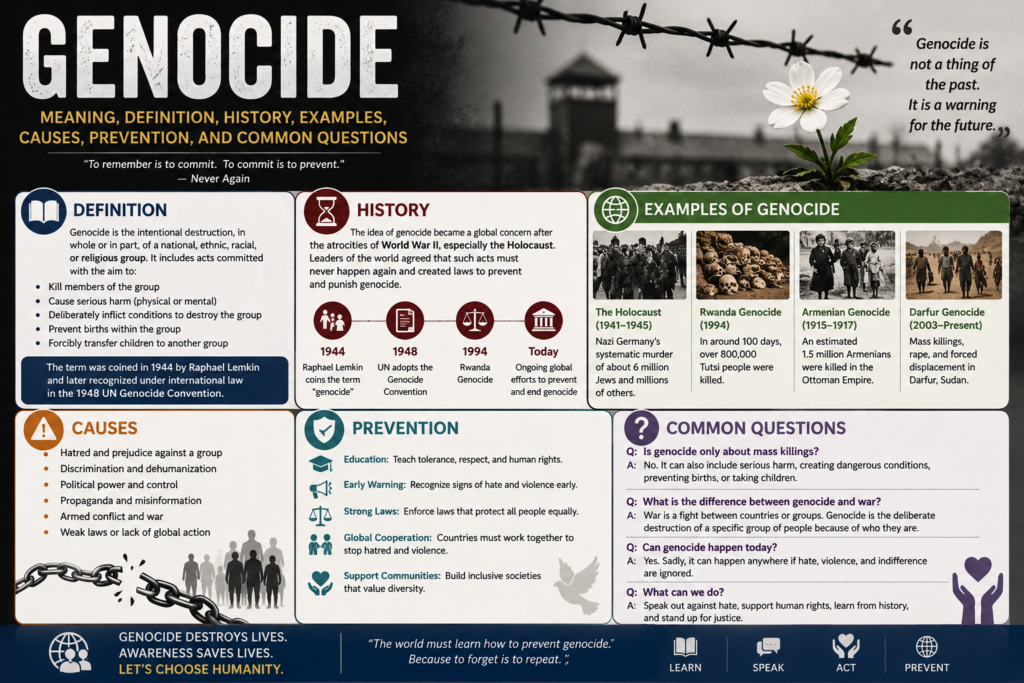

The genocide meaning is important to understand because the word describes one of the most serious crimes in human history. In simple terms, genocide means the deliberate attempt to destroy, completely or partly, a national, ethnic, racial, or religious group. It isn’t simply another word for war, mass killing, or violence. The term has a specific legal meaning under international law.
Learning about genocide can be difficult, but understanding it helps people recognize warning signs, challenge hatred, and support human rights. History has shown that discrimination and dangerous propaganda can grow when people remain silent. For that reason, knowing the genocide meaning is not only an academic exercise; it’s also part of learning how societies can protect vulnerable communities.
This guide explains the genocide meaning in clear English, including its origin, pronunciation, legal definition, historical background, examples, causes, warning signs, prevention, and frequently asked questions.
What Is the Genocide Meaning in Simple English?
The genocide meaning can be explained simply as the intentional destruction of a particular protected group. The group may be targeted because of its nationality, ethnicity, race, or religion. The goal doesn’t necessarily have to be the physical killing of every member. Certain acts intended to destroy the group can also fall under the legal definition of genocide.
The word is therefore much more specific than terms such as “massacre” or “war.” A conflict may involve large numbers of deaths without legally being genocide. Likewise, genocide can happen during a war, but war itself doesn’t automatically mean genocide.
Under the 1948 Genocide Convention, genocide involves certain prohibited acts committed with the intent to destroy, in whole or in part, a national, ethnical, racial, or religious group. This specific intent is one of the most important parts of the genocide meaning.
Genocide Meaning and Pronunciation
The word genocide is commonly pronounced:
JEN-uh-side
Its pronunciation can be written approximately as /ˈdʒenəsaɪd/.
The word has two important parts. “Genos” comes from Greek and relates to a group, race, or people, while “cide” comes from Latin and means killing or destruction. The modern word was created in the twentieth century to describe the destruction of groups of people.
It’s worth remembering that the word’s history is closely connected with international efforts to create a clear legal term for a terrible form of organized persecution. Understanding this background makes the genocide meaning easier to understand.
Where Did the Word Genocide Come From?
The term genocide was coined by Polish-Jewish lawyer Raphael Lemkin during the 1940s. Lemkin wanted a word that could describe the systematic destruction of a human group. Existing words did not fully capture what he was trying to explain.
Lemkin combined elements from Greek and Latin to create the term. His work later influenced international law, particularly the United Nations Convention on the Prevention and Punishment of the Crime of Genocide, adopted in 1948.
This was a major development in international human rights law. Before the term became widely accepted, there wasn’t a single internationally recognized legal word that clearly described the intentional destruction of a protected group. The history of the word helps explain why the genocide meaning is so precise.
Genocide Meaning Under International Law
The legal definition of genocide is narrower than its everyday use. Under the Genocide Convention, genocide consists of specific acts committed with the intent to destroy, in whole or in part, a national, ethnical, racial, or religious group.
The convention identifies several acts that can constitute genocide when they are carried out with the required intent:
- Killing members of the protected group.
- Causing serious bodily or mental harm to members of the group.
- Deliberately creating living conditions intended to bring about the group’s physical destruction.
- Imposing measures intended to prevent births within the group.
- Forcibly transferring children from the group to another group.
The key point is intent. A terrible event doesn’t automatically qualify as genocide simply because many people were harmed or killed. Legal authorities must consider evidence about the purpose and circumstances behind the acts.
That distinction is central to the genocide meaning and prevents the word from being used as a general label for every large-scale tragedy.
Genocide Meaning vs. War, Ethnic Cleansing, and Crimes Against Humanity
People sometimes use genocide, war crimes, ethnic cleansing, and crimes against humanity as if they’re interchangeable. They’re not. Although these concepts can overlap, international law treats them as different crimes.
| Term | General Meaning | Key Feature |
| Genocide | Intentional destruction of a protected group | Specific intent to destroy the group |
| War crime | Serious violation of the laws of armed conflict | Usually connected to an armed conflict |
| Crimes against humanity | Certain widespread or systematic attacks against civilians | Widespread or systematic nature |
| Ethnic cleansing | Removing a population from a particular area | Forced displacement or removal |
Ethnic cleansing, for example, isn’t a separate crime with one universally accepted treaty definition in the same way genocide is. Some acts associated with ethnic cleansing may constitute war crimes, crimes against humanity, or genocide depending on the facts and intent.
So, while these terms may appear together in history books and news reports, their meanings shouldn’t be mixed up. Getting this distinction right is an important part of understanding the genocide meaning.
What Are the Main Elements of Genocide?
There are two broad elements that are especially important when examining genocide: the prohibited acts and the specific intent behind them.
The first element concerns what happened. The acts must fall within the categories recognized by the Genocide Convention. Simply treating people unfairly, although potentially serious and unlawful, isn’t automatically genocide.
The second element concerns why the acts were committed. Prosecutors and courts may examine speeches, policies, patterns of behavior, orders, documents, and other evidence to determine whether there was an intention to destroy a protected group.
This makes genocide legally difficult to establish. A court must look beyond the number of victims and examine the nature, circumstances, and purpose of the conduct. That’s another reason why the genocide meaning should be understood carefully rather than used as a casual description.
Historical Examples of Genocide
History contains several events that have been recognized as genocide by international courts, governments, historians, or other authoritative bodies. Studying these cases can help people understand how persecution can develop into organized destruction.
The Holocaust
The Holocaust was the systematic persecution and murder of approximately six million Jews by Nazi Germany and its collaborators during the Second World War. Other groups were also persecuted and murdered by the Nazi regime.
The Holocaust remains one of the most extensively documented examples of genocide. It demonstrates how government power, propaganda, discrimination, forced removal, imprisonment, and mass murder can become part of a larger campaign against a targeted population.
The Cambodian Genocide
Under the Khmer Rouge regime in Cambodia, from 1975 to 1979, huge numbers of people died through executions, persecution, forced labor, starvation, disease, and other forms of mistreatment.
The Extraordinary Chambers in the Courts of Cambodia later dealt with genocide charges concerning particular protected groups, including Vietnamese and Cham communities. The case shows why legal definitions matter: different crimes can occur within the same period, but the legal classification depends on evidence and intent.
The Rwandan Genocide
In 1994, genocide against the Tutsi in Rwanda resulted in the deaths of hundreds of thousands of people over roughly one hundred days. The violence was accompanied by extremist propaganda and organized persecution.
The International Criminal Tribunal for Rwanda played an important role in prosecuting individuals responsible for genocide and other crimes. The Rwanda case also became an important lesson about the consequences of failing to respond quickly to warning signs.
The Srebrenica Genocide
In July 1995, the massacre at Srebrenica during the Bosnian War was determined by international courts to constitute genocide. Thousands of Bosnian Muslim men and boys were killed.
International judicial institutions, including the International Criminal Tribunal for the former Yugoslavia and the International Court of Justice, have played important roles in establishing the legal findings surrounding Srebrenica.
These historical examples demonstrate why learning the genocide meaning requires both historical knowledge and careful attention to legal definitions.
What Causes Genocide?
Genocide doesn’t usually appear out of nowhere. It can develop through a combination of political, social, economic, and historical conditions.
One common warning sign is extreme discrimination. When authorities or powerful groups begin treating a community as less deserving of rights, violence can become easier to justify.
Another factor can be dehumanizing propaganda. When people are repeatedly described as dangerous, inferior, or responsible for society’s problems, hatred may become normalized. Propaganda can be especially powerful when combined with censorship and control over information.
Other risk factors can include:
- Political instability.
- Armed conflict.
- Extreme nationalism.
- Long-standing discrimination.
- Economic or social crises.
- Government-controlled propaganda.
- Weak institutions.
- Impunity for earlier abuses.
- Leaders who encourage hatred against a particular group.
- Forced separation or persecution of communities.
None of these factors alone proves that genocide is taking place. However, together they can create dangerous conditions. That’s why recognizing these patterns is an important part of understanding the genocide meaning.
How Propaganda Can Contribute to Genocide
Words can have powerful consequences. Before and during some genocides, targeted groups have been portrayed as enemies, criminals, outsiders, or threats to society.
Propaganda can spread through newspapers, radio, speeches, posters, television, and, today, digital platforms. Repeated messages can make discrimination appear normal and can encourage people to stop seeing members of another group as individuals.
This doesn’t mean that every offensive statement leads to genocide. However, systematic incitement and dehumanizing language can be serious warning signs, particularly when powerful institutions use them alongside discriminatory policies or organized violence.
In other words, understanding the genocide meaning also means understanding how language, misinformation, and prejudice can influence real-world behavior.
Warning Signs That Societies Should Take Seriously
Experts and international organizations have identified patterns that can indicate an increased risk of mass atrocities. These signs should never be ignored.
Important warning signs may include:
- Increasing discrimination against a specific group.
- Removal of basic rights from targeted communities.
- Hate speech becoming common or officially supported.
- Political leaders openly encouraging hostility.
- Armed groups targeting civilians.
- Forced displacement.
- Restrictions on humanitarian assistance.
- Destruction of cultural or religious institutions.
- Widespread impunity for serious abuses.
- Government policies designed to isolate a population.
Early warning doesn’t mean every situation will eventually become genocide. Instead, it provides an opportunity for governments, communities, international organizations, and ordinary citizens to act before conditions become worse.
That’s one of the most hopeful lessons connected to the genocide meaning: prevention is possible when warning signs are recognized early.
How Can Genocide Be Prevented?
Preventing genocide requires more than responding after violence has already begun. Prevention can involve education, diplomacy, strong laws, responsible leadership, and protection of vulnerable communities.
Education
Education can help people understand history and recognize the dangers of prejudice. Teaching students about past atrocities can encourage critical thinking and respect for different communities.
Strong Institutions
Independent courts, free media, accountable governments, and reliable legal systems can make it harder for leaders or organizations to abuse power without consequences.
Early International Action
International organizations can monitor situations where communities face serious persecution. Diplomatic pressure, mediation, humanitarian assistance, sanctions, and other measures may help reduce risks.
Protecting Human Rights
Strong protections for equality, freedom of religion, freedom of expression, and other fundamental rights can help prevent discrimination from becoming institutionalized.
Challenging Hate and Misinformation
People can also play a role by questioning false claims and refusing to spread messages that encourage hatred. It may sound like a small thing, but responsible communication matters.
Prevention is therefore a shared responsibility, and understanding the genocide meaning gives people a clearer framework for recognizing why prevention matters.
Why Is It Important to Learn About Genocide?
Studying genocide isn’t about focusing only on the darkest parts of history. It can also teach valuable lessons about human rights, responsibility, courage, and prevention.
History shows that ordinary institutions and communities can be affected when discrimination becomes accepted. It also shows that individuals can make choices that either strengthen harmful systems or help protect others.
Learning about genocide encourages people to ask important questions:
- Are all groups being treated equally?
- What happens when hateful ideas become normal?
- How should societies respond to persecution?
- Why are independent institutions important?
- What can people do when they see discrimination?
These questions make the study of the genocide meaning relevant beyond history lessons. They connect directly to the broader principles of dignity, equality, and human rights.
Common Misunderstandings About Genocide
There are several common misunderstandings surrounding the word.
One is that genocide always requires the killing of every member of a group. That’s incorrect. The legal definition includes several acts, and the required intent concerns destruction of a group in whole or in part.
Another misunderstanding is that genocide is simply another word for war. It isn’t. War describes armed conflict, while genocide focuses on the intentional destruction of a protected group.
Some people also believe that the number of victims alone determines whether an event is genocide. In reality, the legal analysis is more complicated. Intent, protected group status, and prohibited acts are central to the legal definition.
Finally, calling something genocide isn’t simply a matter of choosing the strongest possible word. Legal findings require careful examination of evidence. This is why precision matters when discussing the genocide meaning.
Genocide Meaning in Everyday Conversation
In everyday language, people sometimes use “genocide” to describe extremely large-scale destruction or suffering. However, using the word accurately is important because it has a specific meaning in international law.
When discussing historical or current events, it’s better to rely on trustworthy evidence and distinguish between legal findings, expert analysis, allegations, and personal opinions.
For students and general readers, a useful rule is simple: don’t use genocide as a synonym for every form of mass violence. Instead, ask whether the facts fit the recognized legal definition.
This approach makes conversations clearer and more respectful toward victims and survivors while keeping the genocide meaning accurate.
The Role of International Law
International law has developed several mechanisms for addressing genocide and other mass atrocities. The Genocide Convention was a landmark agreement because it recognized genocide as an international crime and established obligations for countries to prevent and punish it.
International and national courts can investigate and prosecute individuals accused of genocide, depending on jurisdiction and the circumstances of a case. Importantly, genocide is a crime associated with individual criminal responsibility; governments, military leaders, political officials, and other individuals can potentially face legal consequences when the necessary elements are proven.
International law doesn’t erase the suffering caused by atrocities, of course. But legal accountability can help establish facts, punish perpetrators, and preserve historical records.
Understanding this legal framework adds depth to the genocide meaning and shows why the term carries such serious responsibility.
Genocide and Human Rights Education
Human rights education is one of the strongest long-term tools for preventing prejudice and discrimination. Young people can learn how equality, dignity, freedom, and respect help create healthier societies.
Schools and communities can encourage students to examine historical sources, question propaganda, and understand different perspectives. They can also teach students how stereotypes develop and why treating an entire population as responsible for the actions of individuals is dangerous.
The goal isn’t simply to memorize historical dates. It’s to develop the ability to recognize harmful patterns and think critically about information.
That makes education an important part of the wider genocide meaning and its prevention.
Frequently Asked Questions About Genocide Meaning
What does genocide mean in simple words?
Genocide means the intentional destruction, in whole or in part, of a national, ethnic, racial, or religious group. International law recognizes specific acts as genocide when they are committed with the required intent.
Is genocide the same as war?
No. War involves armed conflict, while genocide has a specific legal meaning involving the intent to destroy a protected group. Genocide can happen during a war, but not every war involves genocide.
Who coined the word genocide?
Raphael Lemkin, a Polish-Jewish lawyer, coined the term in the 1940s. His work helped shape the development of international law concerning genocide.
When was genocide recognized as an international crime?
The United Nations Genocide Convention was adopted in 1948. It established genocide as an international crime and required countries that joined the convention to work toward its prevention and punishment.
Does genocide always mean mass killing?
No. Killing is one of the acts included in the legal definition, but the convention also recognizes other acts when they are committed with the required intent to destroy a protected group.
Why is intent important in genocide cases?
Intent helps distinguish genocide from other serious crimes. A court generally needs to establish that the accused had the specific intention to destroy a protected group, in whole or in part.
Can genocide be prevented?
Yes. Prevention can involve early warning systems, education, protection of human rights, diplomacy, accountable institutions, and action against serious discrimination and incitement to violence.
Final Thoughts on Genocide Meaning
The genocide meaning refers to the intentional destruction, in whole or in part, of a national, ethnical, racial, or religious group through acts recognized under international law. The concept is much more precise than simply describing a war or large-scale violence.
Understanding the term requires attention to history, law, intent, and human rights. From the origin of the word to the development of the Genocide Convention, the subject shows how the international community has tried to recognize and prevent some of humanity’s most serious crimes.
Most importantly, studying the genocide meaning isn’t only about looking backward. It can help people recognize discrimination, question dangerous propaganda, defend human dignity, and understand why early action matters. By learning from history and supporting equality and human rights, societies can work toward a future in which such atrocities are less likely to occur.
Stay connected with VoxTrend for the latest ideas, trends, updates & inspiring stories!