
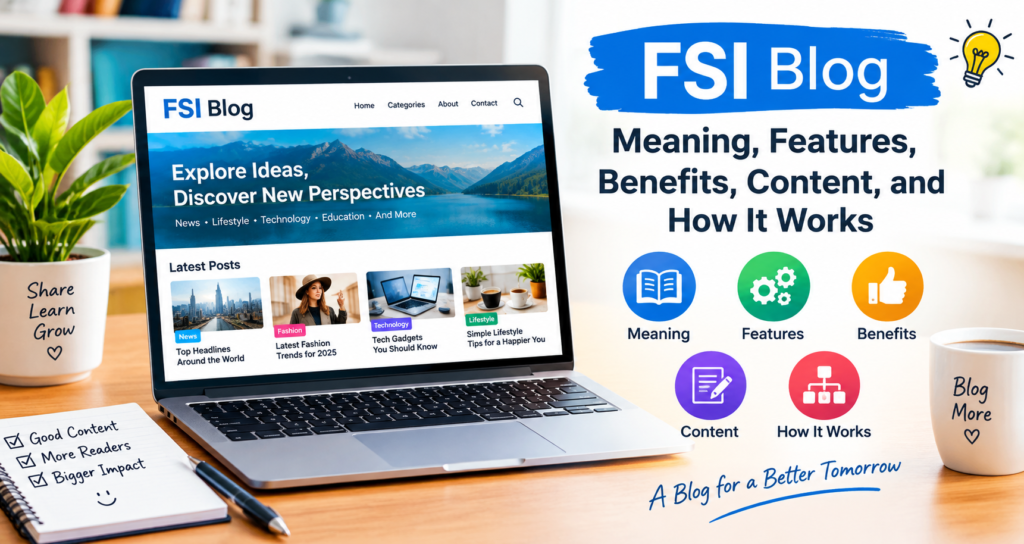

fsi blog is a term that can refer to a blog focused on the Financial Services Industry, while it can also be used as the name of a specific multi-niche blogging platform. Because the abbreviation “FSI” has several meanings, context matters when trying to understand what an FSI blog actually offers.
In the blogging world, an FSI blog can cover subjects such as finance, banking, fintech, insurance, technology, business, education, and other areas. A currently active platform called fsiBlog describes itself as an international multi-niche blogging platform covering Education, Health, Finance, Technology, Web Hosting, Fashion, News, Travel, and Business.
For readers, such a platform can provide a convenient place to explore different subjects. For writers, it can offer an opportunity to publish informative content and reach a broader audience. So, what makes an FSI blog useful, and how should readers and writers understand it? Let’s take a closer look.
What Does FSI Blog Mean?
The phrase fsi blog doesn’t have just one universal meaning. The abbreviation FSI can represent different concepts depending on the context.
In financial publishing, FSI commonly refers to the Financial Services Industry. This broad sector includes organizations involved in banking, insurance, payments, investments, lending, wealth management, and financial technology.
However, FSI can also refer to other concepts. For example, the Financial Stability Institute is part of the Bank for International Settlements and focuses on financial stability and regulatory matters. In real estate, FSI can mean Floor Space Index, a measurement used in urban planning and construction.
Therefore, readers shouldn’t automatically assume that every website using “FSI” is about the same subject.
For the specific website fsiBlog, the site’s own description identifies it as an international multi-niche blogging platform rather than a publication restricted to one financial topic.
Understanding the FSI Blog Platform
The website known as fsiBlog presents itself as a broad information platform. Its stated purpose is to provide useful and understandable content to readers across different categories.
Its listed categories include:
- Education
- Health
- Finance
- Technology
- Web hosting
- Fashion
- News
- Travel
- Business
This multi-niche structure is important because it means visitors don’t have to approach the site only as a specialist financial publication.
For example, one visitor might be interested in an educational topic, while another may be researching finance or technology. A third reader might simply want to explore travel or business information.
The website’s recent content demonstrates this broad approach. Recent articles have covered subjects such as heart disease warning signs, Ayurvedic healthcare, personal loans, home-appliance financing, education, and college information.
That variety is one of the defining characteristics of the platform.
Why Multi-Niche Blogging Matters
Multi-niche websites have become common because readers often search for information about many different areas during the same week.
Think about an ordinary internet user. One day, they might search for a technology guide. The next day, they could need information about education. Later, they might read a business article or a travel guide.
A multi-niche blog can serve these changing interests.
There are several potential advantages:
- Variety: Readers can discover different subjects in one place.
- Accessibility: Articles can explain complex ideas in simpler language.
- Discovery: Visitors may encounter subjects they weren’t originally searching for.
- Writer opportunities: Contributors can write about different areas of expertise.
- Broader audience: Content can appeal to people with different interests.
Of course, variety also creates a challenge. A broad website must maintain quality across every category. Otherwise, readers may find some articles useful while others lack sufficient depth.
Main Categories Found on FSI Blog
The categories of an FSI blog can help readers understand what kind of information they may find there.
Education
Education content can include schools, colleges, courses, examinations, learning resources, study guidance, and educational institutions.
The goal of good educational writing should be clarity. Readers shouldn’t have to struggle through complicated language just to understand a basic concept.
Health
Health is another area where responsible content matters greatly.
Articles in this category may discuss general health information, wellness, medical terminology, or healthcare services. Because health information can affect real-life decisions, readers should always distinguish general educational content from professional medical advice.
Finance
Finance content can cover personal loans, financial concepts, business finance, banking, investments, and economic topics.
Financial writing should be particularly careful with dates, numbers, regulations, and changing market conditions. A useful article should explain information rather than make unsupported promises.
Technology
Technology changes quickly. A technology section may discuss software, websites, digital services, artificial intelligence, cybersecurity concepts, hosting, or emerging tools.
Because technology develops rapidly, publication dates are important. An article that was accurate several years ago might not describe the current situation.
Web Hosting
Web hosting is an important topic for website owners and bloggers.
Content in this area may explain domains, hosting plans, servers, website performance, security, backups, and related concepts.
For beginners, straightforward explanations can make technical subjects much easier to understand.
Fashion
Fashion content can include trends, clothing ideas, styles, brands, accessories, and lifestyle-related topics.
Good fashion writing doesn’t have to be complicated. Clear descriptions, practical information, and current context can make these articles more useful.
News
A news section can provide updates about current events and developments.
However, news changes quickly. Readers should check publication dates and look for reliable sources when a story involves important or rapidly developing information.
Travel
Travel content can discuss destinations, attractions, transportation, planning, culture, and practical travel information.
For travel readers, current information is especially valuable because opening hours, prices, transportation arrangements, and entry requirements can change.
Business
Business articles can explore companies, entrepreneurship, marketing, workplace subjects, industry developments, and financial concepts.
This category can appeal to students, business owners, professionals, and general readers interested in how companies operate.
FSI Blog as a Guest Posting Platform
One of the notable features described by fsiBlog is its role as a guest posting platform.
According to the site’s own description, writers, bloggers, and digital creators can contribute content and share their knowledge with a wider audience. The platform says it welcomes both experienced writers and beginners.
Guest posting generally means creating an article for publication on another website.
For a writer, the process can provide several learning opportunities:
- Practicing professional writing
- Researching unfamiliar subjects
- Learning editorial requirements
- Building a portfolio
- Reaching new readers
- Developing a consistent publishing habit
- Improving understanding of online content
However, publishing isn’t simply about placing words on a webpage. Strong guest posts should provide genuine value to readers.
What Makes an FSI Blog Article Useful?
A useful article should answer a real question or explain a subject clearly.
Several characteristics can make a blog post stronger:
| Quality | Why It Matters |
| Accuracy | Helps readers avoid misleading information |
| Clear language | Makes difficult subjects easier to understand |
| Originality | Gives readers something useful rather than copied material |
| Structure | Helps visitors find important information |
| Freshness | Keeps time-sensitive information relevant |
| Evidence | Supports important factual claims |
| Reader focus | Keeps the article useful and practical |
| Good formatting | Makes longer articles easier to read |
The fsiBlog website states that it aims to publish well-researched, plagiarism-free, reader-focused material.
Those principles are useful for any serious blog, regardless of its niche.
How Writers Can Create Better Content for FSI Blog
Writing a good article starts with understanding the reader.
Before opening a writing tool, a contributor should ask:
Who will read this?
A beginner may need basic definitions and examples. An experienced professional may want detailed analysis, statistics, and industry-specific information.
After identifying the audience, the writer can build the article around a clear purpose.
A simple process might look like this:
- Choose a specific topic.
- Identify the main question.
- Research reliable information.
- Organize the key points.
- Create useful headings.
- Write in clear language.
- Add examples where appropriate.
- Check important facts.
- Review grammar and readability.
- Update information that may have changed.
- Remove unnecessary repetition.
This approach sounds simple, but it can make a huge difference.
SEO and FSI Blog Content
Search engine optimization, or SEO, can help useful articles become easier to discover.
However, SEO shouldn’t mean filling an article with the same keyword again and again. Search engines and readers both benefit from natural, helpful writing.
A practical SEO approach includes:
Search Intent
Understand what someone actually wants when they search for a topic.
Useful Headings
Use descriptive H2 and H3 headings that make the article easy to scan.
Natural Keywords
Include important terms where they make sense rather than forcing them into every paragraph.
Internal Linking
Relevant internal links can help readers discover related information.
Reliable External Sources
When an article makes important factual claims, reputable sources can provide additional evidence.
Mobile-Friendly Formatting
Short paragraphs, clear headings, tables, and bullet points can make articles easier to read on smaller screens.
The fsiBlog platform itself describes its content as SEO-friendly and focused on reader engagement.
Why Originality Matters on an FSI Blog
Originality is more than changing a few words in an existing article.
A genuinely useful article should bring together information in a fresh, organized, reader-friendly way.
For example, instead of copying a definition from another website, a writer can:
- Explain the concept in simple language.
- Give a real-world example.
- Explain why it matters.
- Discuss common mistakes.
- Answer related questions.
This creates an article that teaches rather than simply repeats.
The fsiBlog platform states that it encourages original and non-plagiarized writing.
That principle is particularly important for guest contributors who want to build a professional reputation.
Trust and Accuracy on FSI Blog
Trust is especially important when a blog discusses finance, health, business, or news.
Readers should be able to distinguish between:
- Verified facts
- Expert opinions
- Personal experiences
- Predictions
- Marketing claims
- General educational information
For example, an article about a financial product should not present a potential outcome as a guaranteed result.
Likewise, a health article should avoid presenting general information as a personal diagnosis.
Strong content also benefits from transparent sourcing. If statistics, government rules, research findings, or company announcements are discussed, readers should be able to understand where the information originated.
In short, don’t just tell readers something. Show them why the information deserves attention.
FSI Blog for Readers
From a reader’s perspective, a multi-niche platform can be useful when someone wants to explore several subjects without visiting many different websites.
A reader might use the site to:
- Learn about a new subject
- Research a general question
- Explore technology topics
- Read business information
- Discover educational resources
- Explore travel ideas
- Read finance-related articles
- Find fashion content
- Browse current articles
Still, readers should use good digital habits.
When an article involves health, finance, law, current events, or another high-stakes subject, it makes sense to verify important information using authoritative sources.
A blog can be a useful starting point, but it doesn’t necessarily replace a government website, professional adviser, qualified healthcare provider, academic source, or official company announcement.
How FSI Blog Can Help New Writers
Starting as a writer can feel intimidating. There’s a lot to learn, from research and grammar to SEO and formatting.
A guest posting environment can give new writers practical experience.
A beginner might start with a subject they understand well. Then, gradually, they can experiment with more complex topics.
Useful writing habits include:
- Research before drafting.
- Avoid unsupported claims.
- Keep paragraphs focused.
- Explain technical terms.
- Use examples.
- Check spelling and grammar.
- Don’t copy other articles.
- Write for humans first.
- Edit before submitting.
- Keep learning.
Nobody becomes an expert overnight. Writing improves through practice, feedback, and careful revision.
Challenges of Running a Multi-Niche FSI Blog
A multi-niche platform also faces several challenges.
Maintaining Consistent Quality
Different categories require different knowledge. A website covering health, finance, technology, and travel needs careful editorial standards across all of them.
Keeping Information Current
Some topics change rapidly. News, technology, finance, and regulations can become outdated quickly.
Building Authority
A broad website may need to work harder to establish expertise in individual subject areas than a specialist publication.
Avoiding Low-Value Content
Publishing frequently isn’t enough. Readers need useful information, not simply more pages.
Managing Different Audiences
Someone visiting for a technology guide may have very different expectations from someone reading a health article.
These challenges aren’t impossible to solve. Strong editorial standards, accurate research, clear organization, and regular updates can help.
How to Evaluate an FSI Blog Before Trusting Its Content
Readers can use a simple checklist.
Check the Author
Look for information about who wrote the article and whether the author appears qualified to discuss the subject.
Check the Date
For rapidly changing subjects, publication and update dates matter.
Check the Sources
Important claims should ideally have credible supporting evidence.
Check the Language
Be cautious when an article makes extreme promises or uses sensational language without evidence.
Compare Important Claims
If the subject could affect your health, money, education, or legal situation, compare it with authoritative sources.
Look at the Purpose
Ask whether the article is educational, promotional, opinion-based, or news reporting.
These habits can help readers become more confident online researchers.
The Future of FSI Blog and Digital Publishing
Blogging continues to change as readers move between websites, social platforms, video, podcasts, newsletters, and AI-powered search tools.
For platforms like fsiBlog, this creates both opportunities and challenges.
Future content may increasingly include:
- Interactive guides
- Short videos
- Infographics
- Data visualizations
- Audio content
- Expert interviews
- Step-by-step tutorials
- Frequently updated guides
Artificial intelligence is also changing how people discover and produce information. Yet human editorial judgment remains valuable.
Why? Because information isn’t useful simply because it exists. Someone needs to decide whether it is relevant, accurate, understandable, and appropriate for the audience.
That human-centered approach can help blogs remain useful even as technology changes.
Frequently Asked Questions About FSI Blog
What is an FSI blog?
An FSI blog can refer to content focused on the Financial Services Industry, but the term can have other meanings depending on context. The website fsiBlog describes itself as an international multi-niche blogging platform covering areas including education, health, finance, technology, fashion, news, travel, and business.
Is FSI Blog only about finance?
No. The fsiBlog platform describes itself as multi-niche and lists several categories beyond finance, including education, health, technology, fashion, news, travel, and business.
Can writers contribute to FSI Blog?
The platform states that it welcomes writers, bloggers, and digital creators and offers guest posting opportunities.
What kind of articles can appear on an FSI blog?
Depending on the meaning of FSI and the specific website, content can range from financial-services topics to technology, business, education, health, travel, and other subjects.
Is FSI the same as Financial Services Industry?
In many finance-related contexts, FSI means Financial Services Industry. However, FSI can have other meanings, so readers should consider the context in which the abbreviation is being used.
Why is original content important?
Original content gives readers a reason to visit a website. It can explain information in a new way, combine useful evidence, provide examples, and address questions that readers actually have.
What should readers check before trusting an article?
Readers should consider the author, publication date, sources, evidence, purpose, and whether important claims can be confirmed through authoritative sources.
Final Thoughts on FSI Blog
fsi blog can represent different ideas depending on context, but the active fsiBlog platform presents itself as a broad international multi-niche blogging and guest posting website. Its stated categories cover education, health, finance, technology, web hosting, fashion, news, travel, and business, giving readers and contributors a wide range of subjects to explore.
For readers, the biggest value of a multi-niche blog is convenience and discovery. For writers, it can provide a place to practice publishing, share knowledge, and connect with a wider audience. At the same time, responsible reading remains important: check dates, examine sources, distinguish facts from opinions, and verify high-stakes information through authoritative sources.
As online publishing continues to evolve, the strongest blogs won’t simply chase traffic. They’ll focus on clarity, originality, accuracy, and genuine reader value. That’s what can make an fsi blog useful in a crowded digital world.
Stay connected with VoxTrend for the latest ideas, trends, updates & inspiring stories!