
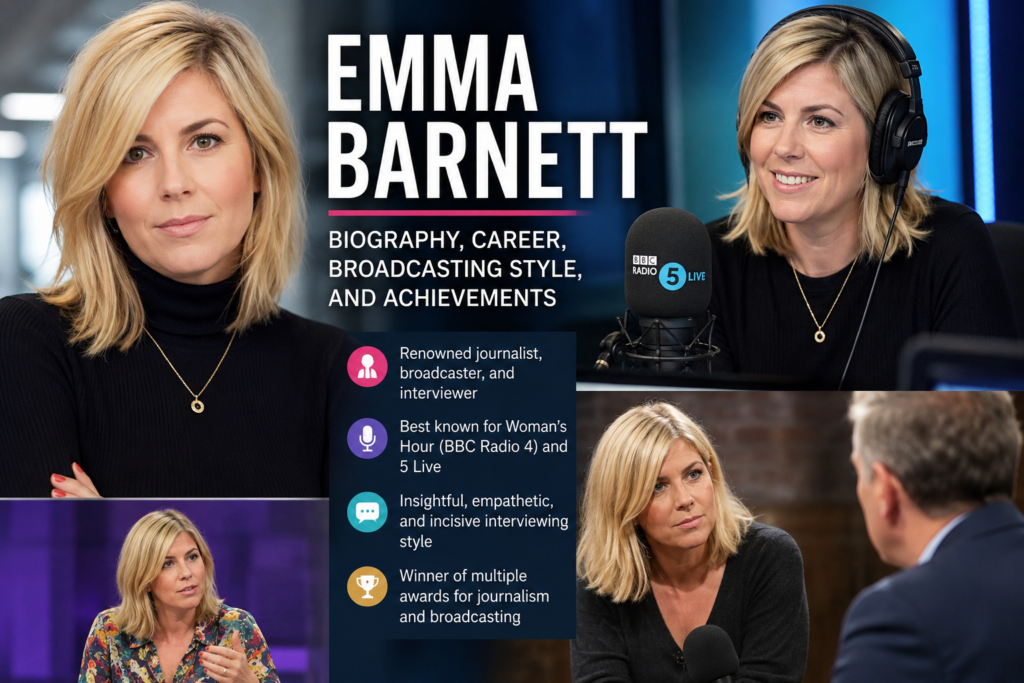

Emma Barnett is a British journalist, broadcaster, and author known for her confident interviewing style, clear questions, and ability to discuss complicated subjects in a way that feels understandable to a wide audience. Born in Manchester in 1985, she developed an interest in journalism during her university years before building a career across newspapers, radio, and television. Her work has taken her from print journalism into some of the BBC’s best-known programmes.
Over the years, Emma Barnett has become especially recognised for live broadcasting and serious interviews. She has worked with BBC Radio 5 Live, appeared on Newsnight, presented Woman’s Hour, and later joined BBC Radio 4’s Today programme. Her career is a useful example of how strong communication skills, curiosity, preparation, and confidence can help a journalist grow across different forms of media.
Emma Barnett Early Life and Background
Emma Barnett was born in Manchester and grew up in an environment that encouraged education and curiosity. She later studied history and politics at the University of Nottingham, where she became involved in student journalism. This early experience gave her an opportunity to develop the skills that would later become central to her professional life: researching subjects, asking questions, writing clearly, and understanding different viewpoints.
Her early career wasn’t limited to broadcasting. Before becoming a familiar radio and television voice, Barnett worked in journalism and media roles, including positions connected with the Daily Telegraph and LBC. These experiences exposed her to different newsroom cultures and helped her understand the pressure of producing information quickly and accurately. Her move from newspapers into broadcasting eventually opened the door to a much wider public audience.
Emma Barnett’s Journalism Career
The professional journey of Emma Barnett shows a steady move from traditional journalism toward live broadcasting. Her background in print journalism helped her develop research and writing skills, while radio taught her how to communicate naturally and respond quickly when conversations don’t go according to plan.
She joined the BBC in 2014 as a presenter on Radio 5 Live. In 2016, she launched her own Radio 5 Live programme, giving her a major platform to develop her distinctive interviewing approach. Her work was recognised when she was named Radio Broadcaster of the Year in 2018.
Her broadcasting work also expanded beyond radio. She became part of the Newsnight presenting team and appeared on programmes including Question Time, Politics Live, and The Andrew Marr Show. She also became known for interviewing politicians and public figures on difficult subjects, building a reputation for persistence without losing sight of the human side of a story.
Emma Barnett and BBC Radio 5 Live
BBC Radio 5 Live played an important role in the rise of Emma Barnett. The station’s fast-moving format requires presenters to handle breaking news, interviews, audience reactions, and live discussions. For a journalist, that’s a demanding environment because there isn’t always time to pause and rethink the next question.
Barnett’s experience on the station helped sharpen the qualities that later became strongly associated with her work. She developed a reputation for being prepared, direct, and willing to challenge guests when an answer didn’t fully address the question. Her Radio 5 Live programme also allowed her to combine current affairs with conversations about everyday life, giving listeners both serious analysis and accessible discussion.
Emma Barnett and Woman’s Hour
One of the most important chapters in Emma Barnett’s career began when she was selected as the main presenter of BBC Radio 4’s Woman’s Hour. She took over the role in January 2021 after Jane Garvey and Jenni Murray stepped down from their long-running presenting positions.
The appointment attracted considerable attention because Woman’s Hour has a long broadcasting history and covers subjects ranging from politics and culture to family life, health, work, relationships, and social issues. Barnett brought a faster and more news-focused style to the programme while maintaining its tradition of giving space to important conversations.
Her first week demonstrated the range of subjects she was willing to tackle. The programme included political discussions and interviews involving issues such as government decisions and international affairs. Reviews of her early broadcasts highlighted her confidence, strong news sense, and willingness to ask difficult questions.
Why Her Woman’s Hour Role Mattered
The importance of Emma Barnett at Woman’s Hour wasn’t simply about taking over a famous broadcasting position. It also showed how established programmes can change while retaining their core purpose.
Barnett brought experience from political journalism and live news into a programme that regularly discusses personal experiences and social questions. That combination allowed her to move between hard news and human stories without treating either as less important.
Her approach can be described through several qualities:
- Strong preparation before interviews
- Direct but understandable questioning
- Interest in everyday experiences
- Willingness to discuss subjects that people may find difficult
- Ability to connect personal stories with wider social issues
- Confidence during live broadcasts
- A focus on allowing guests to explain their views
Emma Barnett as an Interviewer
Interviewing is one of the areas where Emma Barnett has built a particularly strong reputation. Good interviewing isn’t simply about asking lots of questions. A successful interviewer needs to listen carefully, understand what a guest has said, notice when an answer avoids the main issue, and decide when a follow-up question is necessary.
Barnett’s style is often described as direct and persistent. That can sometimes make an interview feel challenging, but difficult questions are an important part of journalism. When a public figure gives an unclear response, asking for clarification can help the audience understand what the person actually means.
At the same time, her work isn’t limited to political interviews. She has spoken with writers, artists, campaigners, academics, entertainers, and people sharing deeply personal experiences. Her career demonstrates that interviewing requires flexibility because the tone needed for a political discussion isn’t always appropriate for a personal conversation.
Emma Barnett and Health Awareness
Another significant part of Emma Barnett’s public work has involved conversations about women’s health. She has spoken openly about her experiences with endometriosis and adenomyosis and has used her platform to encourage greater awareness of subjects that can sometimes be ignored or misunderstood.
Her book Period: It’s About Bloody Time was published in 2019. The book explored menstruation, social attitudes, and the experiences of people dealing with period-related problems. Her willingness to discuss these subjects publicly helped bring wider attention to issues that many people had traditionally found uncomfortable to discuss.
This part of her career also illustrates an important feature of public-interest journalism: personal experience can sometimes help a journalist understand why a subject matters, but accurate reporting still requires evidence, context, and careful questioning. Barnett’s work has combined personal storytelling with broader conversations about health and society.
Emma Barnett’s Book and Writing
Writing has remained an important part of Emma Barnett’s professional identity. Her book about periods is one of the clearest examples of her interest in turning complicated or uncomfortable subjects into accessible conversations.
The subject of menstruation has often been surrounded by embarrassment and silence. By addressing it openly, Barnett contributed to a wider public discussion about health, education, language, and social attitudes. Her approach reflects a broader principle in journalism: sometimes a topic becomes easier to understand when someone is willing to ask the question that other people avoid.
Her writing also complements her broadcasting career. Radio and television require quick responses, while a book provides more room for research, explanation, reflection, and detailed storytelling. Together, these forms of work show the different skills involved in modern journalism.
Emma Barnett and Television Broadcasting
Although Emma Barnett is strongly associated with radio, television has also played an important role in her career. She has appeared on Newsnight and has presented or contributed to major BBC political programmes.
Television interviewing brings a different set of challenges. A presenter has to think about the audience, timing, visuals, the wider programme, and the importance of keeping a conversation focused. Barnett’s experience across radio and television has allowed her to develop a broad broadcasting skill set.
Her television work has also placed her in conversations with politicians and other influential figures. This requires careful preparation because viewers expect journalists to understand the subject rather than simply read prepared questions.
Emma Barnett and the Today Programme
In 2024, Emma Barnett joined BBC Radio 4’s Today programme. The move represented another major step in her broadcasting career. She joined the programme after Martha Kearney’s departure and became part of a presenting team that includes other established BBC journalists.
The Today programme has a particularly demanding format because it combines breaking news, politics, interviews, analysis, culture, and listener-focused discussion. Presenters need to move quickly between subjects while maintaining accuracy and a calm tone.
For Barnett, the move also built on years of experience with live radio. Her background meant she was already familiar with early-morning broadcasting, political interviews, and the need to respond quickly when major news develops.
Emma Barnett’s Broadcasting Style
The style of Emma Barnett is one of the reasons she has become recognisable to audiences. She tends to ask questions in straightforward language and doesn’t always accept an answer at face value.
That approach can be useful in journalism because public discussions can become complicated very quickly. A clear follow-up question can turn a vague statement into something the audience can actually understand.
Her style also includes warmth and curiosity. Although she has earned a reputation for tough questioning, profiles of her career have also described her as approachable and interested in other people. This balance is important because strong interviewing isn’t simply about confrontation; it’s about finding useful information.
Emma Barnett’s Approach to Difficult Conversations
Journalists often have to discuss subjects involving grief, health, politics, family, discrimination, or personal hardship. Such conversations require care as well as confidence.
Emma Barnett has spoken about the challenge of emotionally demanding interviews. Her experience shows that journalists need to create enough space for guests to explain themselves while also keeping the conversation useful for listeners and viewers.
A thoughtful interviewer should avoid turning a serious personal story into entertainment. Instead, the goal should be to help the audience understand the issue while treating the person involved with respect. This principle is particularly important when interviews involve vulnerable people or sensitive subjects.
Emma Barnett and Her Personal Life
Public figures often attract curiosity about their families, but responsible reporting should focus on information that is genuinely relevant and publicly documented. Emma Barnett is married to Jeremy Weil, and they have children. Public profiles have discussed how she has balanced family life with a demanding broadcasting career.
Her experience of motherhood has also influenced some of her public writing and interviews. She has spoken about maternity leave and the challenges of returning to demanding professional work after having children. These discussions have contributed to wider conversations about working parents and the realities of balancing career responsibilities with family life.
Rather than presenting work-life balance as something that can always be solved perfectly, Barnett’s experiences show that it can involve constant adjustment. Some days go smoothly; others don’t. That’s part of the reality for many working families.
Emma Barnett’s Creative Side Projects
Interestingly, Emma Barnett has also explored creative work outside traditional broadcasting. In 2024, reports highlighted a colouring-book project she developed with her husband, Jeremy Weil. The idea began with local London landmarks and grew into a wider community-focused project involving places across the UK and beyond.
The project is an interesting reminder that journalists and broadcasters can have creative interests outside their main careers. A person who spends much of their professional life asking questions and reporting the news may also enjoy projects that are playful, visual, and community-focused.
For Barnett, the project also reflected her interest in family life and local communities. It showed a different side of her personality from the serious interviews audiences usually see and hear.
Emma Barnett’s Major Career Highlights
The career of Emma Barnett includes several milestones that help explain her position in British broadcasting.
| Career stage | Key development |
| Early journalism | Worked in newspapers and media before moving fully into broadcasting |
| BBC career | Joined BBC Radio 5 Live as a presenter |
| Radio 5 Live | Developed her own programme and became a prominent live broadcaster |
| Award recognition | Named Radio Broadcaster of the Year in 2018 |
| Television | Became associated with programmes including Newsnight |
| Woman’s Hour | Became the main presenter in 2021 |
| Authorship | Published Period: It’s About Bloody Time |
| Today programme | Joined BBC Radio 4’s Today in 2024 |
| Creative work | Developed community-focused colouring books with her husband |
These milestones show a career built across several areas rather than around one single programme. Her progression from newspapers to radio and television demonstrates the value of developing transferable journalism skills.
Emma Barnett’s Impact on Modern Journalism
One reason Emma Barnett stands out is her willingness to combine traditional journalistic standards with modern communication. Audiences today consume information through radio, television, podcasts, websites, social media, and streaming platforms. A broadcaster therefore needs to communicate clearly across different settings.
Barnett’s career also demonstrates the value of asking questions that ordinary people might ask themselves. Political language can sometimes become complicated, while health and social issues can be surrounded by technical terms. A skilled presenter can help bridge that gap.
Her work on women’s health has also shown how journalism can challenge silence around subjects that deserve greater public attention. When a respected broadcaster discusses a subject openly, it can encourage audiences to learn more and have conversations of their own.
What Makes Emma Barnett Successful?
There isn’t one secret behind Emma Barnett’s career. Instead, several skills appear to have worked together over time.
Curiosity
Curiosity is essential for journalism. A presenter needs to want to know why something happened, what it means, and how it affects people.
Preparation
Live interviews can move quickly, so preparation matters. Understanding the background of a subject makes it easier to ask useful follow-up questions.
Confidence
Broadcasting involves speaking to large audiences and influential guests. Confidence helps a presenter remain focused even when a conversation becomes difficult.
Listening
Perhaps surprisingly, good interviewing depends heavily on listening. A presenter can’t ask a strong follow-up question without paying attention to the previous answer.
Adaptability
Barnett’s move between newspapers, radio, television, books, and creative projects demonstrates the importance of adapting to different formats.
Lessons From Emma Barnett’s Career
The professional journey of Emma Barnett offers several useful lessons for people interested in journalism or communication.
First, career paths don’t always follow a straight line. Barnett began in journalism and later developed a major career in broadcasting. Each stage added skills that became useful in the next.
Second, difficult subjects don’t have to be discussed in complicated language. Clear communication can make an important difference, particularly when the audience may not already understand the topic.
Third, asking questions takes courage. A journalist sometimes has to ask something uncomfortable because the answer matters to the public.
Finally, credibility is built over time. It comes from preparation, accuracy, fairness, curiosity, and the ability to keep learning. Those qualities matter more than simply having a loud or memorable personality.
Emma Barnett’s Place in British Broadcasting
Emma Barnett has become part of a generation of British broadcasters who move comfortably between radio, television, print, and digital media. Her work has included politics, current affairs, women’s issues, health, culture, and personal stories.
Her transition to BBC Radio 4’s Today programme in 2024 was particularly significant because it placed her on one of Britain’s best-known news programmes.
Her career also reflects the changing nature of journalism. Modern audiences want reliable information, but they also want presenters who sound human and understand the everyday impact of major stories. Barnett’s combination of direct questioning and conversational communication fits that changing environment.
Frequently Asked Questions About Emma Barnett
Who is Emma Barnett?
Emma Barnett is a British journalist, broadcaster, and author. She has worked across newspapers, radio, and television and is particularly known for BBC programmes including Radio 5 Live, Woman’s Hour, Newsnight, and Today.
Where was Emma Barnett born?
Emma Barnett was born in Manchester, England, in 1985. She later studied history and politics at the University of Nottingham and became involved in student journalism.
What is Emma Barnett famous for?
Emma Barnett is best known for her work as a journalist and broadcaster. She became widely recognised through BBC Radio 5 Live, Woman’s Hour, Newsnight, and later the Today programme.
When did Emma Barnett join Woman’s Hour?
Emma Barnett became the main presenter of BBC Radio 4’s Woman’s Hour in January 2021, following the departure of long-serving presenters Jane Garvey and Jenni Murray.
What book did Emma Barnett write?
Emma Barnett wrote Period: It’s About Bloody Time, a book published in 2019 that explores menstruation, social attitudes, and women’s health.
When did Emma Barnett join Today?
Emma Barnett joined BBC Radio 4’s Today programme in May 2024. Her appointment followed Martha Kearney’s departure from the presenting team.
Is Emma Barnett also a television presenter?
Yes. Emma Barnett has appeared on television as well as radio, including work with Newsnight and other BBC current-affairs programmes. Her broadcasting career has therefore covered both audio and visual media.
Emma Barnett: Final Thoughts
Emma Barnett has built a varied career through journalism, radio, television, writing, and creative projects. From her early work in newspapers and student journalism to major roles at the BBC, her professional journey shows how curiosity, preparation, communication, and confidence can create lasting opportunities.
Her work also demonstrates the value of discussing important issues in clear language. Whether she is interviewing a politician, exploring a social question, discussing women’s health, or speaking with someone about personal experiences, her approach is based on asking questions and looking for meaningful answers.
For anyone interested in journalism, Emma Barnett offers an encouraging example of how a career can develop through persistence and a willingness to take on new challenges. Her move from Radio 5 Live to Woman’s Hour and then to Today shows that professional growth often comes from accepting opportunities that demand new skills. In the end, Emma Barnett represents a modern style of broadcasting that combines strong journalism with curiosity, clarity, and a distinctly human voice.
Stay connected with VoxTrend for the latest ideas, trends, updates & inspiring stories!