
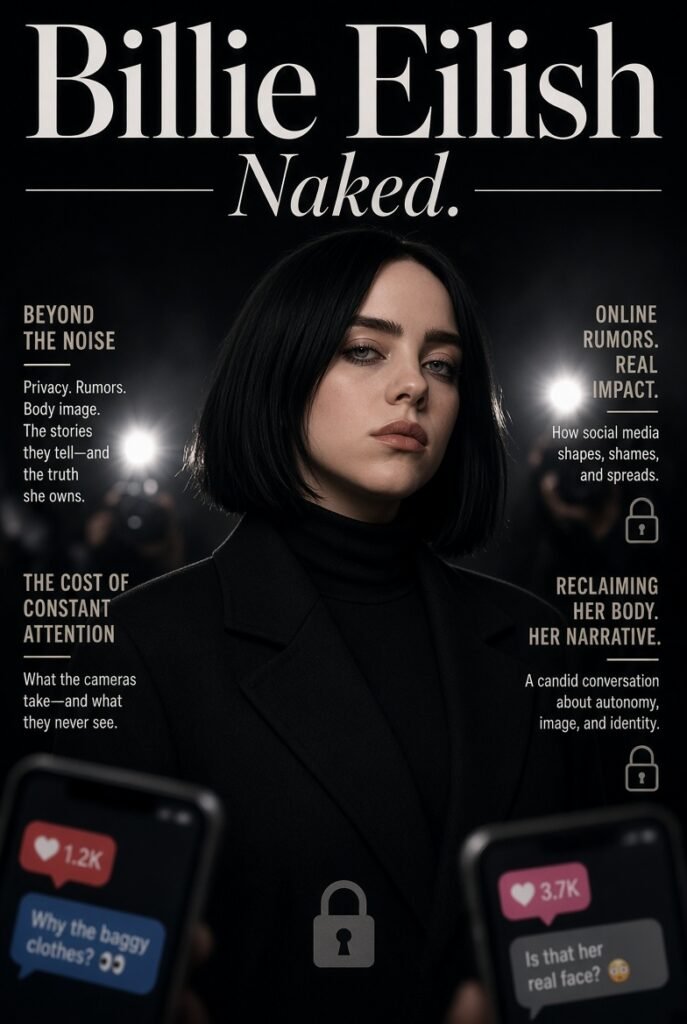

The phrase “billie eilish naked” is widely searched online, but it’s important to understand what such searches can actually mean. In many cases, people encounter headlines, edited images, misleading posts, or rumors that have little connection to verified facts. Because Billie Eilish is one of the most recognizable young musicians in the world, her appearance, clothing, interviews, and personal life often receive intense public attention.
However, searching for or discussing private images of a real person requires care. A celebrity’s public career doesn’t remove their right to privacy. For that reason, responsible readers should distinguish between legitimate public information and material that has been leaked, manipulated, taken out of context, or shared without consent.
Billie Eilish has also spoken publicly about body image, clothing, confidence, and the pressure placed on women in entertainment. These subjects provide a much more useful way to understand why searches such as “billie eilish naked” become popular and what they reveal about modern celebrity culture.
This article explores the subject from a factual, respectful, and media-literacy perspective.
What Does “Billie Eilish Naked” Mean Online?
The phrase “billie eilish naked” can appear in search engines, social media posts, video titles, websites, and discussion forums. Yet the phrase itself doesn’t prove that any particular photograph or claim is genuine.
Online searches can be influenced by:
- Celebrity rumors
- Misleading headlines
- Edited photographs
- Artificially generated images
- Clickbait websites
- Old interviews taken out of context
- Fashion photographs incorrectly described
- Social-media speculation
- Unauthorized material
- Searches for discussions about body image and privacy
This distinction matters because the internet makes it remarkably easy for false information to spread.
A photograph can be cropped, edited, digitally altered, or combined with another image. A headline can also make a harmless photograph sound controversial simply because sensational wording attracts clicks.
Therefore, readers shouldn’t automatically believe everything they see when searching for “billie eilish naked.”
Billie Eilish and Her Approach to Fashion
Billie Eilish has developed a distinctive fashion identity throughout her career. Oversized clothing, bold colors, unusual silhouettes, designer pieces, and experimental styling have all played a role in her public image.
Early in her career, her loose-fitting clothes were particularly noticeable. She explained that wearing oversized clothing helped her feel more comfortable and reduced the amount of attention placed on her body.
That decision became part of a larger conversation about how female performers are treated by the media.
Instead of allowing her body to become the central focus, Eilish often used fashion as a form of creative expression. Her clothing choices could be playful, dramatic, mysterious, elegant, or deliberately unconventional.
Over time, however, her fashion choices have evolved. She has sometimes appeared in more fitted or revealing outfits at public events and photo shoots. This evolution has led to intense online discussion.
But changing one’s style doesn’t mean giving other people permission to invade one’s privacy.
That is an important difference when discussing “billie eilish naked.”
Why Celebrity Body Searches Become So Popular
Celebrity culture has changed dramatically because of smartphones and social media. In the past, fans mainly encountered celebrities through magazines, television, newspapers, and official photographs.
Today, a single photograph can reach millions of people within minutes.
Several factors can drive searches about a celebrity’s body or appearance:
- Curiosity about a famous person’s personal life
- Viral social-media discussions
- Sensational headlines
- Celebrity fashion moments
- Fan communities
- Search-engine trends
- Misleading thumbnails
- False claims
- AI-generated content
- Tabloid-style websites
Unfortunately, curiosity can sometimes encourage websites to create increasingly sensational content.
The result is a cycle: a dramatic headline attracts visitors, more people search for the topic, and websites then create even more articles around the same phrase.
This is one reason a search term such as “billie eilish naked” can become highly visible even when the material associated with it isn’t trustworthy.
Billie Eilish, Body Image, and Public Pressure
One of the most important parts of this discussion is body image.
Billie Eilish has openly discussed the pressure she experienced regarding her appearance. Like many performers, she has faced comments about her weight, clothes, body shape, and overall appearance.
For young people especially, celebrity culture can create unrealistic expectations. Social-media photographs may involve professional lighting, makeup, styling, photography, editing, posing, and carefully selected images.
That means a photograph isn’t necessarily a complete picture of reality.
Eilish’s experiences highlight a broader issue: women in entertainment are often judged by appearance as much as by their professional achievements.
A singer can release a successful album, perform for huge audiences, win major awards, and influence music culture. Yet online discussions can still become focused on her body.
That imbalance is worth questioning.
The Difference Between Public and Private Images
A key principle in responsible celebrity reporting is the difference between public and private material.
A photograph published through an official magazine, verified social-media account, professional event, or legitimate news organization is generally public content.
Private material is different.
It may include:
- Personal photographs
- Images obtained without permission
- Hacked files
- Secret recordings
- Stolen content
- Manipulated photographs presented as genuine
- AI-generated sexual images
- Material shared without consent
Sharing or searching for unauthorized intimate material can contribute to real harm.
Being famous doesn’t mean someone has surrendered every expectation of personal privacy.
This principle is particularly important when discussing “billie eilish naked,” because online searches can mix genuine public photographs with misleading or invasive content.
AI-Generated Images and Celebrity Misinformation
Artificial intelligence has made image manipulation more sophisticated than ever.
Modern tools can create convincing images that appear to show real people in situations that never happened. These images can be created for jokes, entertainment, advertising, misinformation, harassment, or malicious purposes.
Celebrity deepfakes are especially concerning because famous people already have enormous digital footprints.
A fake image can spread through:
- Social-media platforms
- Messaging apps
- Video-sharing websites
- Anonymous forums
- Clickbait blogs
- Search-engine results
- Fake celebrity accounts
Once an image becomes viral, correcting the misinformation can be extremely difficult.
Readers should therefore be cautious whenever they encounter sensational claims connected to “billie eilish naked.”
If an image seems shocking or unbelievable, checking its source is a much better approach than immediately sharing it.
How to Check Whether a Celebrity Claim Is Real
Good media literacy can protect readers from misinformation.
When you encounter a sensational celebrity claim, consider these questions:
Check the Original Source
Ask where the photograph or statement originally appeared.
A trustworthy source should provide enough information to understand the context.
Look for Independent Confirmation
If an important event really happened, reputable publications will often report it independently.
One anonymous website making a dramatic claim isn’t strong evidence.
Examine the Image Carefully
Look for unusual:
- Facial details
- Hands
- Shadows
- Background objects
- Skin texture
- Clothing edges
- Reflections
- Body proportions
AI-generated images can sometimes contain visual inconsistencies.
Check the Date
Old photographs are frequently presented as new.
A photograph from years ago may suddenly become viral because someone gives it a new caption.
Don’t Trust Every Headline
Some websites use extreme headlines because they want clicks.
Read beyond the headline and ask whether the article actually supports its claim.
These habits are useful not only for “billie eilish naked” searches but for celebrity news in general.
Billie Eilish’s Career Is Much Bigger Than Appearance
It’s easy for internet discussions to become distracted by appearance, but Billie Eilish’s career offers a much more meaningful story.
She became internationally successful through music created with her brother Finneas. Her work has included distinctive vocals, atmospheric production, emotionally complex songwriting, and a willingness to experiment.
Her achievements have included major music awards and international recognition.
Her artistic identity is associated with:
- Alternative pop
- Creative songwriting
- Experimental production
- Strong visual storytelling
- Emotional themes
- Distinctive vocal performances
- Innovative music videos
- Changing fashion aesthetics
Her success demonstrates that audiences connect with far more than physical appearance.
When discussions reduce a successful artist to a search phrase such as “billie eilish naked,” they leave out the creativity and work that made her famous in the first place.
Why Oversized Clothing Became Part of Her Image
During the early stages of her career, Billie Eilish became particularly known for oversized clothing.
There were several reasons this style became important to her public identity. It allowed her to experiment with fashion while also reducing unwanted attention toward her body.
Her clothing became almost like a visual signature.
Large jackets, loose trousers, hoodies, unusual accessories, and layered outfits helped create an instantly recognizable image.
This also challenged traditional expectations for female pop stars.
Many female performers are expected to wear highly fitted clothing and maintain a particular appearance. Eilish’s early style offered an alternative.
Her message was simple in principle: an artist should be able to decide how they present themselves.
Changing Fashion Doesn’t Change Personal Boundaries
As Eilish became older, her fashion evolved.
She has appeared in a wider range of styles, including glamorous, fitted, vintage-inspired, and highly stylized outfits. This change has sometimes generated headlines suggesting that she had abandoned her earlier approach to clothing.
But fashion is allowed to change.
People regularly experiment with their appearance as they grow older. A person who wears oversized clothing at one stage of life may later prefer completely different styles.
The same principle applies to celebrities.
A public outfit doesn’t provide permission for strangers to create or distribute private material.
That’s why discussions surrounding “billie eilish naked” should always separate public fashion from private boundaries.
The Role of Social Media
Social media has transformed celebrity relationships.
Fans can now see posts directly from artists rather than waiting for traditional media outlets. At the same time, celebrities can face unprecedented levels of scrutiny.
A single photograph can lead to thousands of comments within hours.
This creates both positive and negative effects.
Positive Effects
- Artists can communicate directly with fans.
- Fans can discover new music quickly.
- Creators can control some parts of their public image.
- Supportive communities can form around artists.
- Important social conversations can reach large audiences.
Negative Effects
- Rumors spread quickly.
- False photographs can go viral.
- Private information may be exposed.
- Harassment can become organized.
- Clickbait can dominate discussions.
- AI-generated misinformation can confuse audiences.
The phrase “billie eilish naked” illustrates how celebrity search culture can turn a person’s appearance into an internet commodity.
Respectful Celebrity Reporting
Responsible reporting doesn’t mean avoiding difficult topics. Instead, it means handling those topics carefully.
A trustworthy article should:
- Separate verified facts from rumors.
- Avoid presenting fake material as authentic.
- Protect personal privacy.
- Identify unreliable claims clearly.
- Avoid unnecessary sensationalism.
- Provide useful context.
- Focus on public information.
- Correct errors when new evidence appears.
This approach benefits readers because it provides information rather than simply generating clicks.
It also creates a healthier online environment.
A Quick Guide to Reliable Sources
Readers can use the following table when evaluating celebrity information:
| Source Type | Reliability | What to Check |
| Official artist account | High | Verify the account |
| Established news organization | Generally high | Look for named sources |
| Major entertainment publication | Usually useful | Check supporting evidence |
| Anonymous social-media post | Low | Find independent confirmation |
| Clickbait website | Low to uncertain | Examine the original source |
| AI-generated image | Not evidence | Look for confirmation |
| Reposted photograph | Uncertain | Find the original publication |
| Fan account | Variable | Treat claims carefully |
No single source is perfect, but reliable information usually has traceable origins.
Protecting Young Readers From Harmful Celebrity Content
Teenagers and young adults are among the most active internet users. They can also be particularly affected by unrealistic standards of beauty.
Celebrity photographs shouldn’t be treated as instructions for how people are supposed to look.
Bodies naturally differ in:
- Height
- Weight
- Shape
- Skin
- Hair
- Muscle
- Proportions
- Age
- Genetics
Online images often show only a carefully selected moment.
It’s healthier to appreciate celebrities for their talents and achievements rather than constantly comparing bodies.
This is another reason why “billie eilish naked” should be approached as a media-literacy topic rather than an invitation to invade someone’s personal boundaries.
Celebrity Culture and the Future of Privacy
Technology will continue to change how people interact with famous individuals.
Artificial intelligence, realistic image generation, face manipulation, and automated content creation are likely to make misinformation even more convincing.
This means digital literacy will become increasingly important.
In the future, readers may need to ask:
- Was this image generated by AI?
- Was the photograph edited?
- Is the account authentic?
- Where did the information originate?
- Has the person actually said this?
- Are reputable sources reporting the same event?
- Is this public information or private material?
These questions can help people navigate the internet more responsibly.
Why Context Matters More Than Clicks
Internet culture often rewards whatever attracts attention fastest.
A shocking phrase can generate thousands of searches, while a careful explanation may receive less attention.
Yet quality information requires context.
The important story surrounding Billie Eilish isn’t simply what she wears or how the internet describes her appearance. It’s her music, artistic development, influence, creative partnership with Finneas, public conversations about body image, and changing relationship with fame.
A responsible reader should look beyond sensational search terms.
In that sense, “billie eilish naked” is best understood as an example of how celebrity curiosity, online privacy, misinformation, and search culture intersect.
Frequently Asked Questions About Billie Eilish Naked
Is every image associated with “billie eilish naked” genuine?
No. Online images can be edited, mislabeled, taken out of context, or generated using AI. A search result isn’t proof that an image is authentic.
Has Billie Eilish discussed body image publicly?
Yes. Body image and the way people comment on her appearance have been recurring subjects in public discussions involving her career and fashion choices.
Why does Billie Eilish’s clothing receive so much attention?
Her fashion has been an important part of her public identity, particularly her early preference for oversized clothing and later experimentation with different styles.
Does being a celebrity mean someone has no privacy?
No. Public figures can have public careers while still maintaining reasonable expectations of personal privacy.
How can readers avoid fake celebrity images?
Check the original source, compare reputable reports, examine the image carefully, check publication dates, and avoid sharing unverified material.
Why do sensational celebrity keywords become popular?
Search trends can be influenced by viral posts, clickbait headlines, social-media discussions, rumors, and algorithmic recommendations.
Final Thoughts on Billie Eilish Naked and Online Responsibility
The phrase “billie eilish naked” may attract significant online curiosity, but the responsible way to approach the subject is through privacy, accuracy, media literacy, and respect.
Billie Eilish is a globally successful musician whose career has been shaped by songwriting, performance, visual creativity, fashion, and a distinctive artistic voice. Her changing appearance and clothing choices are part of her public image, but they shouldn’t be used to justify invasive behavior or the distribution of unauthorized material.
The internet can be entertaining, informative, and inspiring, but it also requires judgment. Before believing a sensational photograph or headline, take a moment to check the source. Before sharing private material, consider the person behind the screen. And before reducing an artist to a provocative search phrase, remember the years of creative work behind the celebrity image.
Ultimately, understanding “billie eilish naked” isn’t about finding inappropriate material. It’s about understanding how celebrity culture, privacy, body image, fashion, misinformation, and modern internet behavior intersect—and why responsible readers should always choose verified information and respect over sensationalism.
Stay connected with VoxTrend for the latest ideas, trends, updates & inspiring stories!