
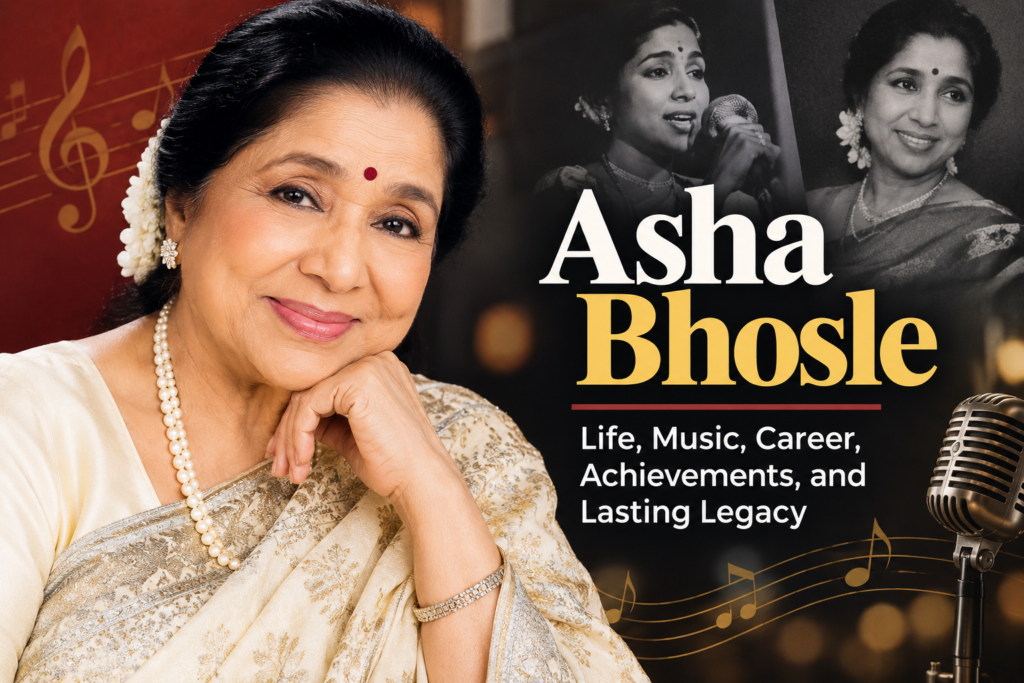

Asha Bhosle was one of the most versatile and influential playback singers in Indian music history. Born on September 8, 1933, in Goar, Sangli State, in present-day Maharashtra, she grew up in a family deeply connected with music and theatre. Over a career spanning more than eight decades, she became known not only for her remarkable voice but also for her ability to move comfortably between film songs, ghazals, classical music, folk, pop, qawwali, and many other styles.
Her journey wasn’t simply about recording thousands of songs. It was about constantly changing, learning, experimenting, and finding new ways to connect with listeners. From her early days in Marathi cinema to becoming an international musical icon, Asha Bhosle built an artistic identity that was very much her own.
Asha Bhosle: Early Life and Musical Family
Asha Bhosle was born into the Mangeshkar family, one of India’s best-known musical families. Her father, Pandit Deenanath Mangeshkar, was a respected classical singer and theatre personality. Music was therefore part of everyday life in the household, and Asha was exposed to singing and performance from a very young age.
Her elder sister was the legendary singer Lata Mangeshkar. Asha also grew up alongside siblings who developed strong connections with music and the arts. After their father’s death when Asha was still a child, the family faced difficult financial circumstances. Asha and her sister Lata began performing and working to help support the family.
This early experience taught Asha an important lesson: talent needed to be supported by discipline and hard work. She wasn’t simply handed a successful career because she belonged to a famous musical family. In fact, she had to establish her own identity in a highly competitive film industry.
Asha Bhosle and Her First Steps Into Singing
Asha Bhosle began her professional singing career as a child. Her early playback work included the Marathi film Majha Bal in 1943, when she was around ten years old. She later entered Hindi cinema, with her early Hindi work helping her gradually build a place in the industry.
The Hindi film music industry of that period was already filled with major singers. Established voices such as Geeta Dutt and Shamshad Begum had strong positions, while Lata Mangeshkar was also becoming increasingly prominent.
So, Asha had to work hard to gain recognition.
Her early career included many assignments that didn’t necessarily receive the attention given to the biggest stars. Yet those experiences helped her develop versatility. Instead of limiting herself to one style, she continued exploring different musical expressions.
That willingness to experiment eventually became one of her greatest strengths.
Asha Bhosle and the Development of Her Unique Style
One of the most interesting aspects of Asha Bhosle was her ability to adapt her voice to different moods and characters.
A singer might be asked to perform a soft romantic melody in one recording session and a lively dance number in another. Asha could make those transitions feel natural. Her voice could sound playful, emotional, energetic, intimate, dramatic, or deeply reflective depending on the requirements of the song.
Her repertoire eventually covered many styles, including:
- Hindi film music
- Marathi music
- Ghazals
- Bhajans
- Qawwalis
- Folk music
- Classical-based compositions
- Pop and Indi-pop
- Western-influenced film music
- International collaborations
Sources documenting her career note that she recorded in more than 20 languages and accumulated a repertoire of more than 12,000 songs.
That’s an extraordinary range.
Asha Bhosle and the Golden Era of Hindi Cinema
The 1950s and 1960s were important years in the development of Hindi film music. During this period, composers were experimenting with new sounds, orchestration, and musical forms.
Asha Bhosle became increasingly important within this changing environment.
She worked with many leading composers and singers, learning how to understand different musical personalities. Her ability to adjust to a composer’s vision made her particularly valuable in the recording studio.
Her voice became associated with a wide variety of actresses and screen personalities. This was one of the special skills of a playback singer: the singer had to make the voice feel believable for the character appearing on screen.
Asha was exceptionally good at this.
Asha Bhosle and R. D. Burman
One of the most important creative relationships in Asha Bhosle‘s career was her partnership with composer Rahul Dev Burman, popularly known as R. D. Burman or Pancham.
Their professional relationship became especially powerful during the 1960s and 1970s. Burman was known for his willingness to experiment with rhythm, instrumentation, jazz, rock, funk, and other influences. Asha’s flexible voice was a natural match for this adventurous musical approach.
Their collaboration produced some of the most memorable recordings in Hindi film music.
Among the songs frequently associated with this creative period are:
- “Aaja Aaja Main Hoon Pyar Tera”
- “Piya Tu Ab To Aaja”
- “Dum Maro Dum”
- “Chura Liya Hai Tumne”
- “O Haseena Zulfonwali”
Rather than simply following musical trends, Asha and Burman often helped create them.
Their professional partnership eventually became personal as well, and they married in 1980. Their musical connection remains an important part of both their legacies.
Asha Bhosle and Her Most Memorable Musical Styles
A major reason Asha Bhosle remained relevant for so many decades was her ability to avoid being trapped in one category.
Some singers become strongly identified with a particular style. Asha, however, could move between contrasting forms.
| Musical Style | What Asha Brought to It |
| Film music | Strong expression and character-based singing |
| Ghazal | Emotional depth and subtle phrasing |
| Pop | Energy and modern vocal expression |
| Folk | Natural rhythm and lively delivery |
| Qawwali | Power, movement, and dramatic expression |
| Classical-based music | Control and musical discipline |
| Dance songs | Playfulness and rhythmic confidence |
| Romantic songs | Warmth and emotional sensitivity |
Her ability to understand the mood behind lyrics was just as important as her vocal range. She didn’t merely sing words; she interpreted them.
That’s why many of her recordings continue to feel alive decades after they were first released.
Asha Bhosle and Umrao Jaan
A particularly important chapter in Asha Bhosle’s career came with the 1981 film Umrao Jaan.
The film’s music required a very different vocal approach from the energetic and Western-influenced songs with which she was also associated. The ghazals demanded elegance, control, emotional restraint, and sensitivity to Urdu poetry.
Asha rose to the challenge.
Her performance in the film demonstrated that she wasn’t limited to lively or glamorous songs. She could also communicate complicated emotions through gentle and sophisticated singing.
Her work on Umrao Jaan helped reinforce her reputation as a singer capable of handling serious musical material.
Asha Bhosle’s Awards and Major Honors
The achievements of Asha Bhosle were recognized through some of India’s most important cultural awards.
Her honors include:
- Two National Film Awards
- Multiple Filmfare Awards
- Filmfare Lifetime Achievement Award
- Dadasaheb Phalke Award in 2000
- Padma Vibhushan in 2008
- Maharashtra Bhushan
- Banga Bibhushan
- Recognition from Guinness World Records
She was also nominated for Grammy Awards during her international career. The Dadasaheb Phalke Award is particularly significant because it is one of India’s highest honors for contributions to cinema.
In 2011, Guinness World Records recognized her as the most recorded artist in music history.
These honors show that her contribution wasn’t limited to commercial success. She became an important part of India’s cultural history.
Asha Bhosle and Her International Influence
Although Asha Bhosle was primarily associated with Indian music, her influence eventually reached audiences outside India.
Her music attracted international listeners because of its rhythm, emotion, unusual arrangements, and distinctive vocal style.
The 1997 song Brimful of Asha by British band Cornershop helped introduce her name to a much wider Western audience. She also participated in collaborations with international artists, including Boy George and Michael Stipe.
This international recognition was important because it showed that Indian film music could connect with listeners who didn’t necessarily understand every word.
Music, after all, can cross language barriers.
Asha Bhosle as a Global Musical Inspiration
Asha’s influence went beyond her own recordings. Younger singers and musicians often looked to her as an example of how an artist could remain curious throughout a long career.
She demonstrated that success doesn’t mean repeating the same formula forever.
Instead, she embraced new sounds and worked with different generations of musicians.
Her career offers several lessons for aspiring artists:
- Don’t be afraid to experiment.
- Develop technical skill through practice.
- Learn from different musical traditions.
- Respect your roots while exploring new ideas.
- Keep improving instead of relying only on past success.
- Build an individual identity.
These lessons are valuable far beyond music.
Asha Bhosle’s Work Beyond Playback Singing
Asha Bhosle was much more than a playback singer.
She also explored other creative and business interests. Her passion for food eventually led to the development of the Asha’s restaurant brand, giving her an opportunity to express another side of her personality and interests.
She also appeared in television and film-related projects and continued performing on stage.
This versatility reflected something important about her personality: she wasn’t interested in being defined by a single professional label.
She was a singer, performer, entrepreneur, cultural figure, and mentor.
Asha Bhosle and Her Relationship With Lata Mangeshkar
It is impossible to discuss Asha Bhosle without mentioning Lata Mangeshkar.
Both sisters became giants of Indian playback singing, but their voices and artistic identities were different.
Lata was widely associated with a highly controlled and classical vocal style. Asha became especially known for her versatility and willingness to explore modern sounds and contrasting genres.
Media reports sometimes presented the sisters as rivals, but their relationship was much more complex than a simple competition. They also performed together and shared a deep family connection.
Their careers demonstrate that two artists from the same family can achieve greatness without becoming identical.
Asha Bhosle’s Personal Resilience
Behind the glamorous world of cinema, Asha Bhosle’s life included significant personal challenges.
She married Ganpatrao Bhosle when she was young, and the marriage later ended. She went on to raise three children and eventually developed her personal and professional life in new directions. Her later marriage to R. D. Burman became one of the most recognized partnerships in Indian music.
Her story therefore isn’t only about fame.
It’s also a story of resilience.
She experienced changes, setbacks, personal difficulties, and professional competition, yet continued to build her artistic career.
That ability to keep moving forward became one of the defining qualities of Asha Bhosle.
Asha Bhosle’s Connection With New Generations
A remarkable part of Asha’s later career was her continued willingness to interact with younger musicians.
Rather than treating music as something belonging only to one generation, she remained open to new sounds and new artists.
Singer Adnan Sami, for example, has spoken about Asha’s influence on his career and remembered her encouragement. Recent tributes have highlighted the way she supported and mentored musicians beyond her own generation.
This is an important part of her legacy.
A great artist doesn’t only create memorable work. A great artist also inspires others to create.
Asha Bhosle’s Final Years and Legacy
Asha Bhosle died in Mumbai on April 12, 2026, at the age of 92. Her death marked the end of a career that had lasted more than eight decades.
Her passing was widely remembered as a major loss for Indian music.
Yet her artistic legacy remains remarkably alive.
Her recordings continue to be listened to, studied, performed, remixed, and rediscovered by younger audiences. Her collaborations continue to attract attention, and her approach to musical experimentation remains relevant.
In that sense, her career didn’t simply end with her final years. It became part of a much larger musical history.
Why Asha Bhosle Remains Important Today
There are many successful singers, but only a few manage to become cultural institutions.
Asha Bhosle achieved that status because she combined several qualities:
- Extraordinary longevity
- Vocal versatility
- Emotional intelligence
- Technical ability
- Willingness to experiment
- Professional discipline
- Cross-cultural appeal
- Strong individual identity
Her career also changed perceptions about what a female playback singer could do.
She could sing a classical composition in one moment and a modern pop-influenced number in another. She could perform intimate ghazals, energetic dance songs, devotional music, folk-inspired pieces, and international collaborations.
That range was her superpower.
Asha Bhosle’s Influence on Indian Film Music
Indian cinema has always depended heavily on music. Songs don’t merely fill time between scenes; they can define characters, communicate emotions, and become cultural memories.
Asha understood this relationship exceptionally well.
Her singing could make an actor appear playful, confident, romantic, mysterious, vulnerable, or powerful. Her voice became part of the storytelling process.
This is why her contribution to cinema should be understood as more than a list of songs.
She helped shape the emotional language of Indian films.
Lessons From Asha Bhosle’s Extraordinary Career
The story of Asha Bhosle provides useful lessons for anyone interested in creativity and long-term success.
Stay Curious
Asha never allowed herself to become completely fixed in one musical category. Her openness to different influences helped keep her work fresh.
Practice Matters
Natural talent can open a door, but sustained success requires discipline. Asha’s long career reflects years of musical learning and professional practice.
Build Your Own Identity
Being Lata Mangeshkar’s younger sister could have overshadowed Asha. Instead, she developed a very different musical identity.
Adapt to Change
Music changed dramatically during her lifetime. Recording technology, musical arrangements, international influences, and audience tastes all evolved. Asha adapted along with them.
Keep Creating
Perhaps the biggest lesson is simple: don’t stop learning just because you’ve already achieved success.
Frequently Asked Questions About Asha Bhosle
Who was Asha Bhosle?
Asha Bhosle was a legendary Indian playback singer known for her extraordinary versatility. She recorded thousands of songs across numerous Indian languages and musical styles during a career lasting more than eight decades.
When was Asha Bhosle born?
Asha Bhosle was born on September 8, 1933, in Goar, Sangli State, in present-day Maharashtra, India.
How many songs did Asha Bhosle record?
Sources commonly credit Asha Bhosle with more than 12,000 recordings across her career, although exact totals can vary depending on how recordings and versions are counted.
Was Asha Bhosle related to Lata Mangeshkar?
Yes. Asha Bhosle was the younger sister of Lata Mangeshkar. Both became internationally recognized figures in Indian playback singing, although their artistic styles developed in different directions.
Who was R. D. Burman to Asha Bhosle?
R. D. Burman was a highly influential Indian composer and Asha Bhosle’s second husband. Their professional collaboration produced many celebrated Hindi film recordings.
What awards did Asha Bhosle receive?
Her major honors included two National Film Awards, Filmfare Awards, the Dadasaheb Phalke Award, and the Padma Vibhushan. Guinness World Records also recognized her as the most recorded artist in music history in 2011.
What made Asha Bhosle different from other singers?
Her extraordinary versatility was one of her defining qualities. She could perform across film music, ghazals, folk, classical-based compositions, pop, qawwali, and other styles while maintaining a recognizable artistic personality.
Conclusion: The Lasting Legacy of Asha Bhosle
Asha Bhosle created a musical legacy that reaches far beyond the number of songs she recorded or awards she received. Her greatest achievement was her ability to keep evolving while remaining unmistakably herself.
From a young performer in the 1940s to one of India’s most respected musical figures, her journey was shaped by discipline, experimentation, resilience, and an extraordinary love for music. She crossed genres, languages, generations, and cultural boundaries.
Her recordings remain an important part of Indian musical heritage, while her openness to new ideas continues to inspire artists around the world. Even after her passing in 2026, the voice and artistic spirit of Asha Bhosle remain deeply woven into the history of Indian music.
Stay connected with VoxTrend for the latest ideas, trends, updates & inspiring stories!