
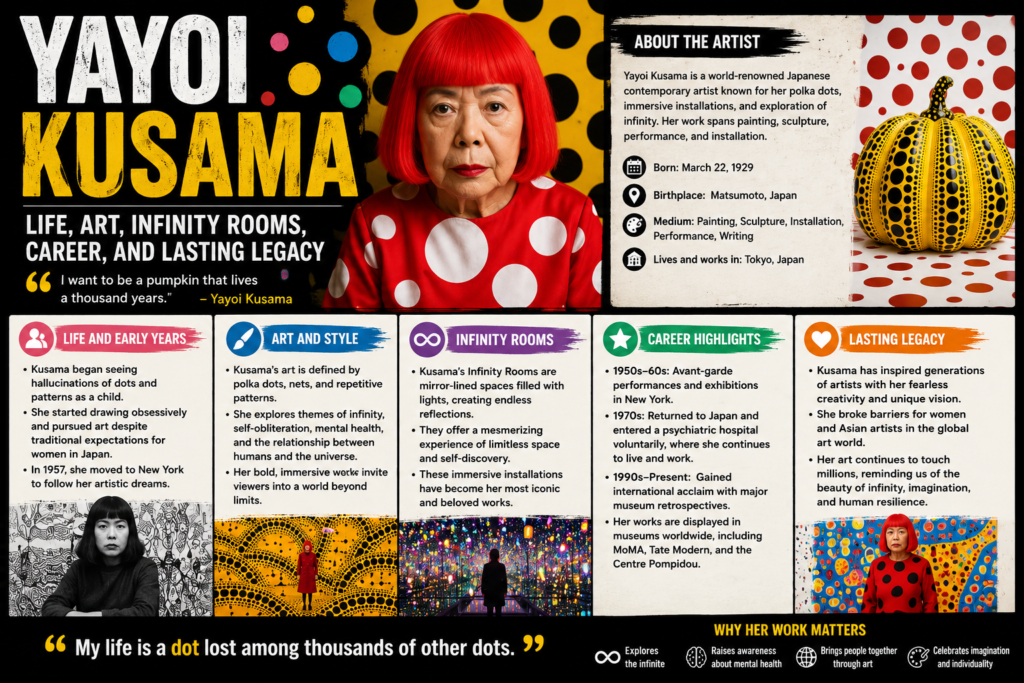

yayoi kusama is one of the most recognizable and influential contemporary artists in the world. Known for her colorful polka dots, mirrored rooms, pumpkins, flowers, sculptures, paintings, and repeating patterns, Kusama has created an artistic language that feels both playful and deeply thoughtful. Her work explores ideas such as infinity, identity, nature, space, repetition, and the relationship between the individual and the universe.
Born in Japan in the early twentieth century, Kusama developed an artistic style that crossed borders and traditional categories. She worked with painting, sculpture, installation, performance, fashion, writing, and other creative forms. Over many decades, her art attracted international attention and helped make immersive installation art a major part of modern museum culture.
Today, yayoi kusama is widely associated with the famous Infinity Mirror Rooms and her signature polka-dot designs. Her career is also important because she continued creating ambitious work despite many personal and professional challenges. Her story shows how a strong artistic vision can develop over time and reach audiences across generations.
Who Is Yayoi Kusama?
yayoi kusama is a Japanese contemporary artist whose career has lasted for many decades. She was born on March 22, 1929, in Matsumoto, Nagano Prefecture, Japan. From a young age, she was interested in drawing and painting, and she developed a strong fascination with repeated patterns and visual experiences.
Kusama’s work doesn’t fit neatly into one artistic category. She has produced paintings, sculptures, installations, films, performances, literary works, and collaborations with designers and fashion companies. Her art often uses repetition as a central idea, allowing a simple shape or pattern to expand until it seems to fill an entire environment.
Her famous dots may look simple at first glance, but they have a deeper role in her artistic ideas. By covering objects, walls, rooms, and sculptures with repeated circles, Kusama can make individual objects appear to disappear into larger fields of pattern.
This approach is one reason yayoi kusama remains such an important name in contemporary art. Her work can be visually exciting for casual visitors while also giving art historians and critics many ideas to study.
Yayoi Kusama Early Life and Artistic Beginnings
The story of yayoi kusama begins in Matsumoto, where she grew up in a family involved in the seed business. Her childhood experiences influenced her imagination and later artistic development. Kusama has spoken and written about seeing visual patterns and unusual forms from an early age, experiences that became important to her creative identity.
She began making drawings and paintings while still young. During this period, she was especially interested in flowers, plants, and repeated forms. Nature later became one of the most recognizable subjects in her work, particularly through her pumpkin sculptures and floral installations.
Kusama also faced resistance from her family regarding her desire to become an artist. At a time when expectations for young women in Japan could be restrictive, pursuing an independent artistic career was not an easy choice.
Nevertheless, she continued developing her work. Her early determination became an important part of the story of yayoi kusama, especially because she eventually moved beyond Japan and entered international artistic circles.
Yayoi Kusama and the Move to the United States
A major turning point came when yayoi kusama moved to the United States in 1957, eventually settling in New York City. She arrived with ambitions that extended far beyond the Japanese art world.
New York was an exciting but demanding environment. The city was becoming a major center for avant-garde art, and Kusama encountered artists and movements that were changing the way people thought about painting and sculpture.
During her years in New York, Kusama developed large-scale works based on repetition. Her early “Infinity Net” paintings became particularly important. These works were made from countless repeated brush marks, creating surfaces that seem to continue beyond the boundaries of the canvas.
Her artistic experiments also expanded into sculpture and installation. Instead of treating a painting as a separate object, Kusama increasingly explored how art could occupy physical space.
This period helped establish yayoi kusama as an artist willing to challenge traditional ideas about what a painting, sculpture, or exhibition could be.
What Makes Yayoi Kusama’s Art Unique?
One of the most interesting things about yayoi kusama is the way she takes simple visual elements and turns them into powerful environments. Dots, nets, mirrors, pumpkins, flowers, and repeated forms appear throughout her career.
Her art often has several qualities at once:
- Bright and memorable colors
- Repeated patterns
- Large-scale installations
- Mirrors and reflections
- Organic shapes inspired by nature
- Themes of infinity and space
- A strong connection between the viewer and the artwork
- A balance between playful appearance and serious ideas
Repetition is especially important. A single dot is ordinary. Thousands or millions of dots can create an entirely different visual experience.
The same idea appears in her mirrored installations. A room containing lights, mirrors, or repeated objects can make visitors feel as though the space continues much farther than it actually does.
In this way, yayoi kusama transforms ordinary visual elements into experiences that encourage people to think about scale, perception, and their own place in the world.
Yayoi Kusama and the Meaning of Polka Dots
Polka dots are probably the visual feature most closely connected with yayoi kusama. Her dots appear on paintings, sculptures, rooms, furniture, pumpkins, clothing, and many other surfaces.
The dots aren’t simply decorative. They are closely connected to Kusama’s interest in repetition and infinity. When dots cover an object completely, the object can seem to lose its separate identity. The pattern becomes more important than the individual surface.
Kusama has described her interest in dots in relation to ideas about the universe and the relationship between the individual and the larger world. A person can be understood as one small element within a much larger existence, just as a single dot becomes part of a huge field of dots.
This is what makes the visual language of yayoi kusama so effective. A visitor doesn’t need to know complicated art theory to enjoy the work, but learning about its ideas can make the experience even more meaningful.
Yayoi Kusama Infinity Mirror Rooms
The Infinity Mirror Rooms are among yayoi kusama‘s most famous creations. These immersive installations use mirrors, lights, repeated objects, and carefully designed spaces to create the impression of an endless environment.
When visitors enter an Infinity Mirror Room, they don’t simply look at a painting from a distance. They become part of the artwork. Their reflection appears alongside the lights, objects, and surrounding space.
The mirrors create a visual effect in which one room appears to extend into many rooms. This sense of endless repetition connects directly to Kusama’s long-standing interest in infinity.
Different Infinity Mirror Rooms have different themes and designs. Some feature glowing lights, while others use colorful objects or reflective surfaces. The experience can feel peaceful, mysterious, playful, or overwhelming depending on the installation.
The popularity of these rooms has also changed how many people experience contemporary art. Visitors often photograph themselves inside the installations, turning the museum experience into something they share with others.
The Infinity Mirror Rooms demonstrate how yayoi kusama transformed an artistic idea into an environment that people can physically enter.
Yayoi Kusama Pumpkins and Their Symbolism
Another major part of yayoi kusama‘s artistic identity is the pumpkin. Her pumpkin sculptures are instantly recognizable because of their strong shapes, bright colors, and repeated dot patterns.
Kusama’s interest in pumpkins is connected to her childhood experiences in Japan. She has expressed affection for the vegetable and has used it repeatedly in paintings, sculptures, prints, and installations.
The pumpkin may seem like a simple subject, but Kusama transforms it through scale and pattern. A familiar object becomes something almost dreamlike when it is enlarged, covered with dots, and placed in an unusual setting.
Her pumpkins also show how yayoi kusama can combine personal memories with universal visual ideas. The sculpture may begin with something familiar from nature, yet the repeated pattern makes it part of a much larger artistic world.
Yayoi Kusama Flowers and Nature
Nature has remained an important source of inspiration for yayoi kusama. Flowers, plants, seeds, pumpkins, and other organic forms appear throughout her career.
Her flower sculptures can be enormous compared with the human body. By changing the scale of familiar natural objects, she makes viewers reconsider their relationship with nature.
A flower that would normally fit in a garden can become a huge installation. A pumpkin can become a large sculpture. Repeated forms can cover an entire room.
This change in scale is an effective artistic tool because it makes everyday subjects feel strange and new.
Kusama’s use of nature also connects with her broader interest in infinity. Plants and flowers grow, reproduce, and repeat patterns. Her art captures that sense of continuing growth through repeated shapes.
For many visitors, the natural imagery makes yayoi kusama‘s work approachable, even when the underlying concepts are complex.
Yayoi Kusama’s Major Artistic Themes
The work of yayoi kusama can be understood through several recurring themes. These themes appear in different forms throughout her career.
Infinity
Infinity is perhaps the strongest idea in Kusama’s work. Repeated dots, nets, reflections, and lights can make a space appear endless.
Repetition
Repetition allows Kusama to transform simple marks into large visual experiences. A repeated shape can become a pattern, and a pattern can become an environment.
Self and Identity
Her installations often place the viewer inside a space filled with reflections. This can raise questions about where one person ends and the surrounding environment begins.
Nature
Flowers, pumpkins, plants, and organic shapes are recurring subjects. Kusama often changes their size, color, or surroundings.
Space
Her installations encourage visitors to think about physical space differently. Mirrors and repeated forms can make a small room seem enormous.
Transformation
Kusama frequently changes familiar objects into strange or unexpected forms. This transformation is central to the visual power of her work.
Together, these themes explain why yayoi kusama has remained relevant across different periods of modern and contemporary art.
Yayoi Kusama’s Career Beyond Painting
Although painting is a major part of yayoi kusama‘s career, her creative work extends much further.
She has produced sculptures, installations, performances, books, films, fashion collaborations, and public artworks. This willingness to experiment has allowed her ideas to move between different artistic formats.
Her literary career is particularly notable. Kusama has written novels, poetry, and other works, demonstrating that her creativity isn’t limited to visual art.
She also participated in performance art during the 1960s. These activities placed her within the experimental art culture of New York, where artists were challenging traditional boundaries between art and everyday life.
By working across different media, Kusama showed that an artist could build a complete creative universe rather than remain tied to one medium.
That flexibility has helped yayoi kusama connect with audiences who may discover her through museums, public sculptures, books, fashion, or digital media.
Yayoi Kusama’s Return to Japan
After spending many years in the United States, yayoi kusama returned to Japan in the early 1970s. Her international career had developed considerably, but the transition back to Japan was another important stage.
Over time, Kusama continued producing art at an impressive pace. Her work increasingly received international recognition, and major exhibitions introduced her ideas to new generations.
She has also worked from a studio environment in Tokyo and has maintained a highly productive artistic practice.
Her later career demonstrates an important lesson: artistic influence doesn’t necessarily depend on following a short trend. Kusama’s visual language remained recognizable while continuing to evolve.
This long-term development is one reason yayoi kusama is considered such an influential figure in contemporary art.
Yayoi Kusama’s Museums and Major Exhibitions
The work of yayoi kusama has been exhibited by major museums and galleries around the world. Her exhibitions have attracted audiences far beyond traditional art communities.
Her installations are particularly well suited to museums because they encourage visitors to experience art physically rather than simply viewing objects from across a gallery.
Some exhibitions have focused on specific parts of her career, while others have presented a broad overview of her artistic development.
Her dedicated museum in Matsumoto, the Matsumoto City Museum of Art, has played an important role in presenting her work in her hometown region. Her work has also appeared in major international institutions, helping establish her as a global contemporary art figure.
These exhibitions have allowed researchers, students, collectors, and casual visitors to study the development of yayoi kusama over many decades.
Quick Facts About Yayoi Kusama
| Topic | Information |
| Full name | Yayoi Kusama |
| Birth date | March 22, 1929 |
| Birthplace | Matsumoto, Nagano, Japan |
| Nationality | Japanese |
| Main fields | Painting, sculpture, installation, performance, literature |
| Famous for | Polka dots, Infinity Mirror Rooms, pumpkins and immersive installations |
| Major themes | Infinity, repetition, identity, nature and space |
| Artistic movement links | Avant-garde and contemporary art |
| Active career | Spanning many decades |
| Known worldwide for | Immersive art installations and distinctive visual style |
Why Yayoi Kusama Is So Popular Today
The continued popularity of yayoi kusama comes from several factors. Her work is visually distinctive, easy to recognize, and highly immersive.
Modern audiences also enjoy experiences that can be photographed and shared. Kusama’s installations naturally encourage this behavior because visitors become part of the visual scene.
However, her popularity isn’t based only on social media. Her work has serious artistic depth and has been studied by museums, scholars, critics, and historians.
Another reason is accessibility. Someone who knows very little about contemporary art can enter a room filled with mirrors and lights and immediately have a reaction. The experience comes before the explanation.
Afterward, visitors can learn about the concepts behind the work. This combination of immediate visual appeal and deeper intellectual meaning has helped yayoi kusama reach an unusually broad audience.
Yayoi Kusama and Popular Culture
yayoi kusama has also become an important figure outside traditional museums. Her distinctive patterns have appeared through collaborations involving fashion, design, retail spaces, and other forms of popular culture.
These collaborations have introduced her visual style to people who may never have visited a contemporary art gallery.
Her work has become recognizable enough that the combination of dots, mirrors, pumpkins, and bright colors can immediately suggest her artistic identity.
At the same time, her popularity raises an interesting question: Can fine art remain meaningful when it becomes part of popular culture?
In Kusama’s case, the answer can be yes. Popular exposure doesn’t automatically remove artistic value. Instead, it can encourage more people to explore the ideas behind the work.
How to Understand Yayoi Kusama’s Art
You don’t need an advanced degree in art history to appreciate yayoi kusama. A simple approach can make her work easier to understand.
First, look at the repeated elements. Ask yourself what happens when one shape appears again and again.
Next, notice the scale. Is an ordinary object much larger than expected? Does a small space feel enormous?
Then, consider your own position. In a mirrored room, you’re not just observing the artwork. Your body and reflection become part of the visual experience.
Finally, think about the larger ideas. Infinity, identity, repetition, nature, and space are recurring concepts throughout her career.
There isn’t always one correct interpretation. Art can produce different reactions in different people, and that openness is part of what makes yayoi kusama‘s work so engaging.
The Influence of Yayoi Kusama on Contemporary Art
The influence of yayoi kusama can be seen in the growing popularity of immersive installations. Her approach helped demonstrate that an artwork could be an environment rather than simply an object hanging on a wall.
Her use of repetition also influenced conversations about minimalism, avant-garde art, installation, and contemporary visual culture.
Kusama’s career is especially significant because she developed a recognizable artistic language and maintained it across decades. Her dots and mirrored spaces aren’t merely trademarks. They form a system through which she explores large philosophical questions.
Her success also helped challenge assumptions about who receives recognition in the international art world.
For younger artists, her career offers an encouraging example of how persistence, experimentation, and a distinctive point of view can eventually create lasting influence.
Yayoi Kusama’s Artistic Legacy
The legacy of yayoi kusama extends beyond individual artworks. She has created a visual language that is instantly recognizable around the world.
Her career also demonstrates the value of persistence. She continued developing her ideas even when recognition wasn’t immediate.
Today, her work can be encountered in museums, galleries, public spaces, books, fashion collaborations, and educational programs. New audiences continue discovering her through immersive installations.
Her influence is likely to remain important because the central ideas in her art are timeless. People continue to wonder about infinity, identity, nature, space, and their place in the world.
That combination of personal vision and universal questions gives yayoi kusama a lasting place in contemporary art history.
Frequently Asked Questions About Yayoi Kusama
What is Yayoi Kusama best known for?
yayoi kusama is best known for her polka-dot artworks, Infinity Mirror Rooms, pumpkins, flowers, sculptures, and immersive installations. Her work is recognized for repetition, bold visual patterns, mirrors, and themes connected to infinity and identity.
What are Yayoi Kusama’s Infinity Mirror Rooms?
The Infinity Mirror Rooms are immersive installations that commonly use mirrors, lights, repeated objects, and enclosed spaces. The reflections can make the environment appear much larger or seemingly endless.
Why does Yayoi Kusama use dots?
Dots are a central part of yayoi kusama‘s artistic language. They represent repetition and can contribute to ideas about infinity and the relationship between an individual object and a much larger universe.
Why are pumpkins important to Yayoi Kusama?
Pumpkins are recurring subjects in Kusama’s art and are connected to her memories and appreciation of the natural world. Her pumpkin sculptures combine familiar organic forms with her signature patterns.
Where was Yayoi Kusama born?
yayoi kusama was born in Matsumoto, Nagano Prefecture, Japan, in 1929.
What types of art does Yayoi Kusama create?
Her career includes painting, sculpture, installation art, performance, literature, film, and collaborative creative projects. She is especially famous for large-scale immersive installations.
Why is Yayoi Kusama important to contemporary art?
She helped expand the possibilities of installation and immersive art. Her long career, distinctive visual language, and international influence have made her an important figure in modern and contemporary art.
Conclusion: The Lasting Power of Yayoi Kusama
yayoi kusama has built an extraordinary artistic career around repetition, infinity, nature, identity, and imagination. From her early drawings in Japan to her international exhibitions and famous Infinity Mirror Rooms, her journey shows how a distinctive creative vision can grow into a global cultural influence.
Her art is memorable because it works on several levels. Children and casual visitors can enjoy the colors and shapes, while experienced art lovers can explore the deeper questions behind them. A field of dots can be playful and philosophical at the same time. A pumpkin can be familiar and mysterious. A mirrored room can be beautiful while also making visitors question their sense of space and identity.
Perhaps that’s the greatest strength of yayoi kusama: her art invites people to look, feel, think, and participate. Her work reminds us that even the simplest visual idea can become powerful when an artist has the courage to repeat it, expand it, and give it new meaning. yayoi kusama remains a remarkable example of creativity, persistence, and the lasting ability of art to connect people with ideas that seem almost infinite.
Stay connected with VoxTrend for the latest ideas, trends, updates & inspiring stories!