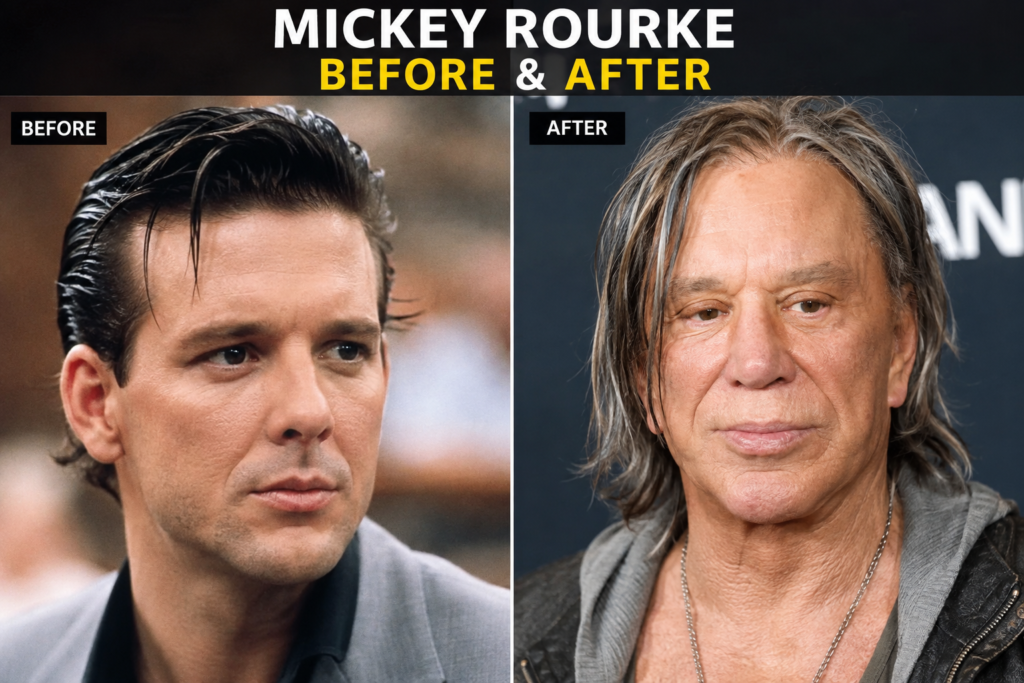

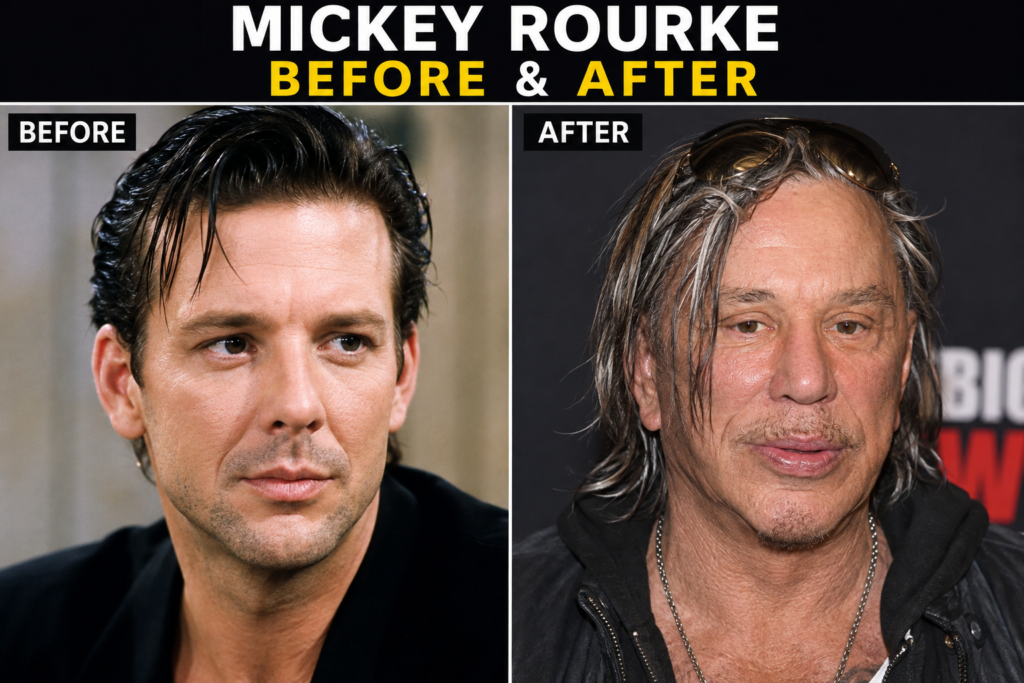
Mickey Rourke before and after is a topic that continues to attract attention because his appearance has changed significantly across several decades. However, the story isn’t simply about cosmetic surgery or getting older. Rourke’s changing face is closely connected to his life as an actor, his years as a professional boxer, facial injuries, reconstructive procedures, and his return to Hollywood. Looking at the complete story gives readers a much clearer picture than simply comparing photographs.
Born Philip Andre Rourke Jr., Mickey Rourke became one of Hollywood’s most recognizable actors during the nineteen-eighties. He gained attention through films such as Diner, Rumble Fish, The Pope of Greenwich Village, 9½ Weeks, Angel Heart, and Barfly. Later, his career took a very different direction when he returned to boxing. According to biographical sources, his professional boxing period involved repeated injuries, including serious facial damage that eventually required several operations.
The subject of Mickey Rourke before and after therefore involves much more than appearance. It’s also a story about fame, career setbacks, personal choices, physical injuries, and one of Hollywood’s most notable acting comebacks. His performance in The Wrestler eventually earned him a Golden Globe and a BAFTA, as well as an Academy Award nomination.
For anyone researching the keyword keyword, understanding this wider context is important. The images may show a dramatic difference, but the life behind those images is even more interesting.
Mickey Rourke Before and After: His Early Life and First Love of Boxing
Before becoming a Hollywood star, Mickey Rourke had a strong connection with boxing. He grew up in Miami after his family moved there from New York, and he began learning boxing at a young age. His early interest in the sport was serious rather than casual. He trained at Miami’s famous Fifth Street Gym, a place associated with major boxing figures.
Rourke eventually built an amateur boxing record and competed in the Florida Golden Gloves. His early boxing ambitions were interrupted by injuries, including concussions. Instead of ending his connection with physical competition forever, however, Rourke discovered acting and eventually moved toward a completely different career.
That early history matters when discussing Mickey Rourke before and after. His later facial changes didn’t happen in isolation. Boxing had already been an important part of his life long before he became known for his distinctive Hollywood appearance.
Mickey Rourke Before and After: His Rise to Hollywood Fame
Rourke’s acting career began in the late nineteen-seventies, and his early performances quickly showed that he had unusual screen presence. His role in Body Heat helped attract wider attention, while Diner established him as a serious young actor. He followed that success with several respected films.
During the nineteen-eighties, Rourke became particularly well known for his combination of intensity, vulnerability, and unconventional charm. His performances in Rumble Fish, The Pope of Greenwich Village, 9½ Weeks, Angel Heart, and Barfly helped make him a major name.
At this stage, photographs of Rourke show a younger actor with the appearance that became closely associated with his early career. His look became part of his public image, but his acting ability was the real foundation of his success.
This is an important point when discussing Mickey Rourke before and after. The “before” period wasn’t simply about physical appearance. It represented a time when Rourke was at the center of Hollywood’s attention and was widely regarded as one of his generation’s promising actors.
Why Mickey Rourke Left Acting for Professional Boxing
Rourke’s career changed dramatically in the early nineteen-nineties. After a difficult period in Hollywood, he decided to return to boxing professionally. His decision was unusual because he was already an established actor, and professional boxing at that stage of life carried obvious physical risks.
Rourke competed in eight professional bouts and remained unbeaten, with reported wins and draws. He trained with experienced boxing professionals, including Freddie Roach. However, the sport came with significant consequences for his body, particularly his face.
According to CBS News, Rourke later explained that his nose was broken repeatedly during his boxing career and that he underwent multiple nose operations. Other biographical accounts describe additional injuries involving his cheekbone and other parts of his face.
This period is one of the most important pieces of the Mickey Rourke before and after story. Some people see photographs from different decades and immediately assume that every change was caused by cosmetic surgery. That conclusion is too simple. Rourke’s documented boxing injuries and reconstructive procedures played a major role in how his face changed.
Mickey Rourke Before and After: The Role of Reconstructive Surgery
Facial surgery is not always performed for cosmetic reasons. In Rourke’s case, his boxing injuries required medical reconstruction. He has spoken publicly about the damage caused by his time in the ring, and sources have reported that surgeons performed operations to repair his nose and other facial injuries.
This distinction is important. Reconstructive surgery aims to repair or restore areas damaged by injury, while cosmetic surgery is generally performed to alter appearance without treating an injury. In real life, the two categories can sometimes overlap, especially when someone has suffered major facial trauma.
Rourke’s own history makes the subject more complicated than many online before-and-after comparisons suggest. Time magazine reported that his appearance in The Wrestler reflected both the consequences of his years in boxing and unsuccessful plastic surgery.
So, when readers search for Mickey Rourke before and after photographs, it’s worth remembering that photographs alone cannot reveal why a particular physical change occurred.
The Difference Between Aging, Injury, and Cosmetic Procedures
One reason the Mickey Rourke before and after topic creates so much discussion is that several factors can affect a person’s appearance over a long period.
These factors include:
- Natural aging over several decades
- Facial injuries from boxing
- Reconstructive operations
- Cosmetic procedures
- Changes in hairstyle and facial hair
- Makeup used for film roles
- Weight and general physical changes over time
- Professional photography, lighting, and camera technology
It would be misleading to attribute every visible difference to one particular procedure without reliable evidence. Celebrity photographs can also look very different depending on the year, styling, lighting, and role.
Rourke’s career is especially unusual because his face has sometimes been transformed for movie characters. His appearance as Marv in Sin City, for example, was heavily shaped by makeup and character design. His role in The Wrestler also required him to portray an aging professional wrestler, creating another visual layer that shouldn’t be confused with his everyday appearance.
Therefore, a responsible discussion of Mickey Rourke before and after should separate documented medical history from speculation.
Mickey Rourke Before and After: The 1990s Career Struggle
Rourke’s transformation wasn’t only physical. His professional life also changed dramatically during the nineteen-nineties.
After leaving boxing, he returned to acting, but Hollywood was no longer offering him the same kind of leading roles he had received during his earlier career. He appeared in several films, including The Rainmaker, Buffalo ’66, and other projects. His career continued, but his position in mainstream Hollywood had changed.
This period has become an important part of his story because it demonstrates how quickly the entertainment industry can change. A performer can be a major star in one decade and struggle to find similar opportunities in another.
Rourke later described that difficult period as a time when he had lost much of the status he once enjoyed. His story wasn’t a straight line from fame to decline. There were setbacks, mistakes, personal struggles, and eventually a renewed determination to work.
The Sin City Comeback Changed How People Saw Him
In two thousand five, Rourke delivered one of the performances that helped change public perception of him. He played Marv in Sin City, a stylized comic-book crime film directed by Robert Rodriguez and Frank Miller.
The role allowed Rourke to use his intense screen presence in a completely different way. With extensive makeup and visual effects, he was transformed into the rough and imposing character. The performance attracted strong attention and helped remind audiences why Rourke had been considered such a compelling actor in the first place.
This is another reason that simple before-and-after photographs don’t tell the whole story. Hollywood frequently changes an actor’s appearance for a character. Makeup, prosthetics, lighting, costumes, and digital effects can make a performer look dramatically different.
The Sin City period became an important stepping stone toward the bigger comeback that followed.
Mickey Rourke Before and After: The Wrestler Era
The most important chapter in the modern Mickey Rourke before and after story came with The Wrestler in two thousand eight.
Directed by Darren Aronofsky, the film tells the story of Randy “The Ram” Robinson, an aging professional wrestler trying to deal with the consequences of his past while searching for a meaningful future. Rourke’s own career history made the role especially powerful because audiences could see parallels between the fictional character’s struggle and the actor’s real-life professional journey.
Rourke’s performance received major critical praise. He won the Golden Globe for Best Actor and the BAFTA Award for Best Actor, while also receiving an Academy Award nomination.
The role was more than a comeback. It demonstrated that Rourke’s value as an actor wasn’t dependent on looking like the young star from the nineteen-eighties.
In fact, the changes in his appearance became part of the emotional power of the performance. Rather than trying to hide every sign of age or history, the film used his mature appearance to make the character feel believable.
What Mickey Rourke’s Appearance Says About His Career
When people discuss Mickey Rourke before and after, they often focus entirely on his face. But his appearance also reflects a broader career journey.
His younger appearance became associated with his rise to fame. His boxing years brought injuries. His later years included reconstructive work, aging, and different approaches to his appearance. Then came film roles that used makeup and character design to create completely new looks.
In other words, his face became part of a much larger story about identity and reinvention.
Rourke’s career also shows that actors don’t have to remain frozen in the image that made them famous. A performer who was once known primarily as a young leading man can eventually become a character actor with a completely different screen presence.
That’s exactly what happened with Rourke. His later work proved that an actor’s career can evolve even after a long period away from the spotlight.
Mickey Rourke Before and After: Career Highlights at a Glance
| Career period | Major development | Why it matters |
| Early years | Amateur boxing and acting training | Built the foundation for his future careers |
| Late 1970s | Early acting roles | Started his professional screen career |
| 1980s | Major film success | Became a prominent Hollywood actor |
| Early 1990s | Returned to professional boxing | Career moved away from mainstream acting |
| Boxing years | Repeated facial injuries | Contributed significantly to later facial changes |
| Mid-to-late 1990s | Returned to acting | Began rebuilding his film career |
| 2005 | Sin City | Major acting comeback |
| 2008 | The Wrestler | Career-defining performance |
| 2010s onward | Continued film work | Established a later-career identity |
This timeline helps explain why the Mickey Rourke before and after discussion can’t be reduced to a single photograph or a single operation.
Did Mickey Rourke Have Plastic Surgery?
This is one of the most common questions connected with Mickey Rourke before and after.
The answer requires some care because there is a difference between documented procedures and internet speculation. Rourke has publicly discussed having operations to repair injuries caused by boxing. Sources have also reported that he underwent several procedures involving his nose and facial reconstruction.
There has also been extensive public discussion about cosmetic surgery and procedures that may have affected his appearance. However, not every claim found online has been independently confirmed by Rourke or a medical professional treating him.
For that reason, reliable articles should avoid presenting rumors as facts.
A better approach is to focus on what is known: Rourke had significant facial injuries during his boxing career, underwent reconstructive procedures, has acknowledged surgery, and has experienced natural aging. These factors together help explain much of the difference seen across photographs.
Why Before-and-After Celebrity Photos Can Be Misleading
Before-and-after celebrity images can be interesting, but they should always be viewed carefully.
A photograph from a film premiere might show professional makeup, studio lighting, carefully selected angles, and a particular hairstyle. Another photograph might be a casual image taken outdoors. Comparing the two as if they were medical photographs can create an inaccurate impression.
The problem becomes even greater when an actor has played characters requiring heavy makeup or prosthetics.
Rourke is a perfect example. His appearances in films such as Sin City demonstrate how dramatically makeup and character design can alter an actor’s face. Therefore, not every dramatic visual difference represents a permanent physical change.
For readers researching Mickey Rourke before and after, the best practice is to compare photographs from similar settings and time periods while also checking reliable biographical information.
Mickey Rourke’s Acting Legacy Goes Beyond His Appearance
Although his changing appearance receives plenty of attention, Rourke’s professional legacy is much broader.
His filmography includes performances in several influential movies, and his work has covered crime dramas, romantic films, action movies, independent cinema, and character-driven dramas. IMDb lists more than one hundred acting credits across his career.
His performance in The Wrestler remains particularly important because it showed that his acting ability could overcome the expectations attached to his earlier image.
That comeback also challenged a common Hollywood idea: that an actor’s value depends on maintaining a youthful appearance. Rourke’s later career demonstrated that experience, character, emotional depth, and screen presence can become even more valuable with age.
His journey is therefore not simply a story about physical transformation. It’s a story about professional reinvention.
The Positive Lesson Behind Mickey Rourke Before and After
There is an optimistic lesson hidden inside the entire Mickey Rourke before and after story.
Careers can change. Appearance can change. Circumstances can change. A person can experience a period when opportunities seem to disappear and still find a way forward.
Rourke’s career included enormous success, major setbacks, a departure from acting, professional boxing, injuries, a difficult return to Hollywood, and eventually award-winning work. His comeback through Sin City and especially The Wrestler showed that a career doesn’t necessarily end simply because someone has experienced a difficult chapter.
His story also encourages a more thoughtful attitude toward celebrity appearances. Instead of judging a person solely by photographs, it’s better to understand the history behind those changes.
The keyword keyword may lead readers to many appearance-focused discussions, but the fuller story is ultimately about resilience, reinvention, and an actor who continued working through dramatic changes in his life.
Frequently Asked Questions About Mickey Rourke Before and After
What caused Mickey Rourke’s facial changes?
A major factor was the facial trauma he experienced during his professional boxing career. Reliable biographical sources report that he suffered several injuries and underwent operations to repair the damage.
Did Mickey Rourke have reconstructive surgery?
Yes. Sources report that Rourke underwent reconstructive procedures after injuries sustained during boxing. His nose and other facial areas required medical attention.
When did Mickey Rourke become famous?
Rourke gained major attention during the nineteen-eighties through films including Diner, Rumble Fish, The Pope of Greenwich Village, 9½ Weeks, Angel Heart, and Barfly.
Why did Mickey Rourke become a professional boxer?
Rourke had a long-standing interest in boxing that began during his youth. After experiencing difficulties in his acting career, he returned to boxing professionally in the early nineteen-nineties.
What was Mickey Rourke’s biggest comeback role?
The Wrestler is widely regarded as his defining comeback performance. His work as Randy “The Ram” Robinson earned him a Golden Globe, a BAFTA, and an Academy Award nomination.
Did makeup affect his appearance in movies?
Yes. Film makeup and character design have played a significant role in some of Rourke’s appearances. His role as Marv in Sin City is a strong example of how makeup can dramatically change an actor’s appearance.
Final Thoughts on Mickey Rourke Before and After
The story of Mickey Rourke before and after is far more complicated than a simple comparison between an older photograph and a newer one. His changing appearance reflects several decades of natural aging, a demanding boxing career, documented facial injuries, reconstructive procedures, professional makeup, and different stages of his acting career.
More importantly, Rourke’s life demonstrates that a career can take unexpected turns. He went from being one of Hollywood’s most talked-about young actors to professional boxing, struggled to regain his place in the film industry, and eventually returned with performances that earned major awards and worldwide recognition.
For anyone searching Mickey Rourke before and after, the most useful takeaway is to look beyond appearance. His face may have changed, but so did his career, his roles, and his perspective as an actor. Ultimately, his story is one of change, perseverance, and reinvention—and that’s what makes the Mickey Rourke before and after journey so fascinating.
Stay connected with VoxTrend for the latest ideas, trends, updates & inspiring stories!