
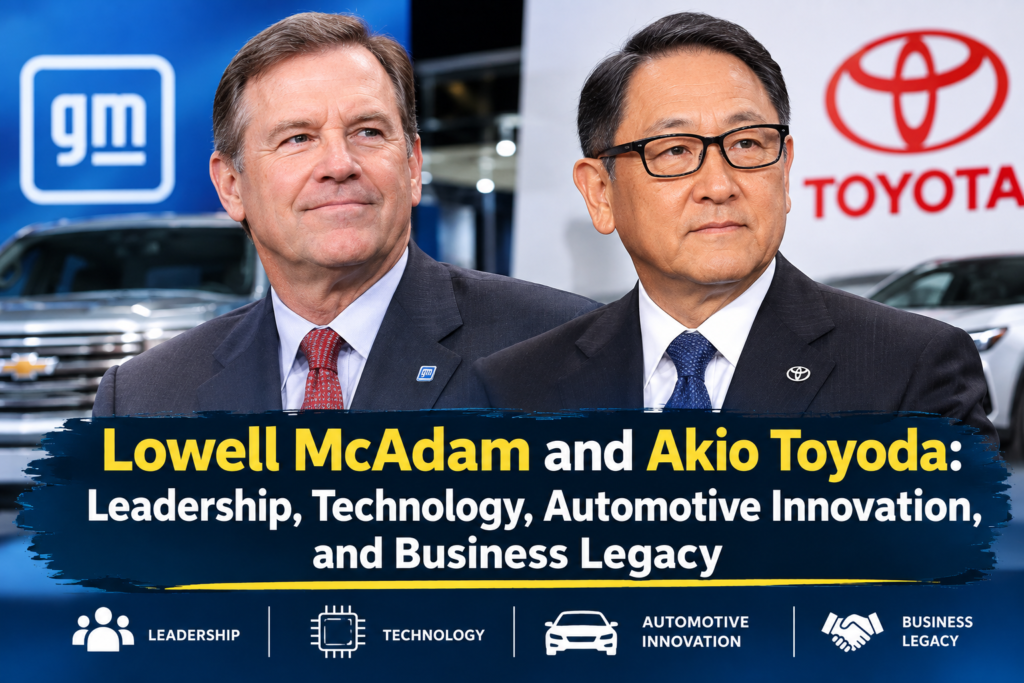

Lowell McAdam and Akio Toyoda are two influential business leaders whose careers developed in very different industries. McAdam built his reputation in telecommunications, eventually becoming chairman and CEO of Verizon Communications. Toyoda, meanwhile, spent decades at Toyota Motor Corporation and became its president in 2009 before moving to the role of chairman in 2023.
At first glance, there might not seem to be much connecting a telecommunications executive from the United States with a Japanese automotive leader. One worked primarily with wireless networks, communications technology, and digital services; the other spent his career around automobiles, manufacturing, mobility, and Toyota’s global operations.
Yet their careers have something important in common: both operated during periods of rapid technological change. McAdam helped guide Verizon as mobile communications and digital services transformed everyday life. Toyoda led Toyota through a period when the automotive industry was being reshaped by connectivity, electrification, software, autonomous-driving research, and changing ideas about mobility.
The phrase lowell mcadam and akio toyoda therefore provides an interesting opportunity to examine two different approaches to corporate leadership. Their stories also show how large companies depend on long-term planning, technology, international experience, and the ability to respond when an industry changes.
Who Is Lowell McAdam?
Lowell C. McAdam is an American business executive best known for his leadership at Verizon Communications and Verizon Wireless.
McAdam earned an engineering degree from Cornell University and later received an MBA from the University of San Diego. Before entering the telecommunications industry, he served six years in the U.S. Navy Civil Engineer Corps and became a licensed professional engineer.
His education and engineering background became useful in a career centered on technology and communications infrastructure.
McAdam joined AirTouch Communications in 1993. He later held leadership positions at Pacific Bell and PrimeCo Personal Communications before becoming an important executive at Verizon Wireless.
His career illustrates how technical knowledge can provide a strong foundation for business leadership. Telecommunications is a complicated field involving networks, engineering, regulation, customer service, spectrum, infrastructure, and rapidly changing technology.
Lowell McAdam’s Rise at Verizon
McAdam joined Verizon in 2000, when Verizon Wireless was being formed through the combination of wireless operations associated with Bell Atlantic and Vodafone AirTouch.
He became president and CEO of Verizon Wireless in 2007 and held that position until 2010. He then moved into senior leadership at Verizon Communications, eventually becoming CEO in 2011 and chairman in 2012.
This was a significant period for the communications industry.
Mobile phones were rapidly changing from simple voice devices into internet-connected computers. Consumers increasingly expected reliable data services, while businesses were beginning to depend heavily on mobile connectivity.
Under McAdam’s leadership, Verizon expanded its focus beyond traditional wireless communications. The company also pursued growth in areas such as digital media and the Internet of Things.
The Conference Board notes that McAdam played a major role in Verizon’s wireless development and that, during his tenure, Verizon acquired Vodafone’s 45% stake in Verizon Wireless, giving Verizon complete ownership of the wireless operation.
McAdam’s Role in the Wireless Revolution
To understand McAdam’s career, it’s helpful to remember how quickly mobile technology changed.
Earlier generations of mobile phones were mainly communication tools. As smartphones became more common, however, mobile networks became platforms for:
- Internet access
- Video streaming
- Mobile applications
- Online shopping
- Digital payments
- Social communication
- Business services
- Connected devices
That transformation created enormous opportunities for telecommunications companies.
McAdam’s career developed during this transition. His background in engineering and network operations gave him experience with the technical side of the industry, while his executive positions required him to think about customers, investment, competition, and corporate strategy.
In other words, his job wasn’t simply about running a network. It was about understanding where communications technology was heading.
Who Is Akio Toyoda?
Akio Toyoda is a Japanese business executive and the chairman of the board of directors of Toyota Motor Corporation.
Toyota’s official biography states that Toyoda was born on May 3, 1956. He graduated from Keio University with a law degree in 1979 and later earned a master’s degree in business administration from Babson College in the United States in 1982. He joined Toyota in April 1984.
His career at Toyota has covered many parts of the automotive business.
He worked in areas involving production, marketing, product development, international operations, and other corporate functions. He also served at New United Motor Manufacturing Inc. (NUMMI), Toyota’s manufacturing joint venture with General Motors in California, beginning in 1998.
That international experience became an important part of his professional background.
Toyoda eventually became president of Toyota in 2009 and moved to chairman of the board in April 2023.
Akio Toyoda’s Long Journey at Toyota
Toyoda’s rise within Toyota wasn’t based on one position or one area of expertise.
His career developed across multiple parts of the company. He became involved with Toyota’s operations in Asia and China, marketing, information technology, product management, quality, purchasing, sales, and overseas operations.
This broad experience gave him an understanding of Toyota from several angles.
That matters in the automotive industry because producing a vehicle involves far more than designing the car itself.
A global automaker must coordinate:
- Engineering
- Manufacturing
- Supply chains
- Sales
- Marketing
- Quality control
- Software
- Safety
- Research and development
- International regulations
- Customer service
Toyoda’s career touched many of these areas.
Lowell McAdam and Akio Toyoda: Two Different Industries
The clearest way to understand lowell mcadam and akio toyoda is to compare the industries in which they built their careers.
| Area | Lowell McAdam | Akio Toyoda |
| Main industry | Telecommunications | Automotive |
| Major company | Verizon | Toyota |
| Education | Engineering and MBA | Law and MBA |
| Early technical background | Engineering and network operations | Automotive operations and manufacturing |
| Major leadership role | Verizon chairman and CEO | Toyota president and chairman |
| International experience | Telecommunications operations across several countries | Toyota operations in Japan and overseas |
| Major technology focus | Wireless networks and digital services | Vehicles, mobility, connectivity, electrification and technology |
| Leadership period | Major smartphone and wireless expansion | Major transformation in global automotive mobility |
The differences are obvious, but there are also meaningful similarities.
Both executives had to manage very large organizations. Both worked with technology-intensive industries. Both had international responsibilities. And both operated in markets where customer expectations and technology changed quickly.
The Importance of International Experience
One of the strongest similarities between the careers of McAdam and Toyoda is international exposure.
Before becoming one of Verizon’s top executives, McAdam worked with international telecommunications operations. The Conference Board notes that he served as a lead technical partner for cellular ventures involving countries including Spain, Portugal, Sweden, Italy, Korea, and Japan.
Toyoda also developed international experience.
His assignment at NUMMI in California placed him inside a major Toyota-General Motors manufacturing partnership in the United States. Later, he supervised operations involving Asia, China, Oceania, the Middle East, and other overseas markets.
For global companies, this kind of experience can be valuable because business practices, regulations, customers, and competitive conditions vary significantly between countries.
Technology as a Common Theme
Technology is another major theme connecting lowell mcadam and akio toyoda.
McAdam’s career centered on telecommunications technology. Wireless networks evolved from early digital systems into sophisticated broadband networks capable of supporting huge amounts of data.
Toyoda’s career involved an equally dramatic technological transformation in transportation.
Modern vehicles increasingly depend on software, sensors, connectivity, advanced driver-assistance systems, batteries, electric motors, and digital services.
This means that an automobile is no longer simply a mechanical machine. Like a smartphone, it can increasingly function as a connected technology platform.
The industries are different, but the leadership challenge is similar: companies must invest in today’s business while preparing for technologies that may become important tomorrow.
Toyoda’s Approach to the Future of Mobility
During Toyoda’s leadership, Toyota increasingly discussed mobility as a broader concept rather than simply automobile manufacturing.
Toyota’s strategy has included work involving electrified vehicles, connected technologies, fuel-cell systems, and other mobility solutions.
Toyoda has also emphasized the idea that Toyota should think about providing different forms of mobility rather than focusing only on selling conventional cars.
This reflects a major change in the automotive industry.
Consumers and governments around the world are paying more attention to:
- Fuel efficiency
- Carbon emissions
- Electric vehicles
- Battery technology
- Hydrogen
- Connected vehicles
- Safety technology
- Autonomous-driving research
- Public and shared mobility
The automobile industry is therefore undergoing a transition comparable in some ways to the communications revolution McAdam experienced.
McAdam and the Rise of Digital Connectivity
McAdam’s career provides a useful example of how communications became central to modern society.
As wireless networks improved, mobile devices became increasingly important for work, education, entertainment, communication, and business.
Verizon invested heavily in network infrastructure during this period.
McAdam’s leadership therefore occurred during a shift from traditional voice-focused telecommunications toward data-centered digital connectivity.
The change was enormous.
Instead of simply asking whether a phone call would connect, customers increasingly cared about questions such as:
- How fast is the mobile internet?
- Can I stream video?
- Does the network work reliably indoors?
- Can my business use mobile cloud services?
- Can connected devices communicate automatically?
- Can a network support millions of devices?
Those questions transformed the telecommunications industry.
The Internet of Things and Connected Technology
One area where McAdam’s Verizon career became particularly relevant was the Internet of Things, often called IoT.
The basic idea is simple: everyday objects can connect to networks and exchange information.
Examples can include:
- Connected vehicles
- Smart energy systems
- Industrial equipment
- Medical monitoring devices
- Security systems
- Logistics equipment
- Smart-home technology
The growth of IoT demonstrated that telecommunications companies were no longer serving only people with phones. Networks were increasingly becoming infrastructure for machines as well.
This idea has an interesting connection with the automotive world.
Modern vehicles themselves can become connected devices, communicating with networks, cloud systems, smartphones, and other infrastructure.
Where Their Business Worlds Overlap
Although there is no prominent public record establishing a major direct partnership between McAdam and Toyoda, their professional worlds naturally overlap in several areas.
Telecommunications networks are increasingly important to connected vehicles.
Automakers need reliable connectivity for services such as:
- Navigation
- Emergency assistance
- Vehicle diagnostics
- Software updates
- Connected entertainment
- Fleet management
- Data services
Telecommunications companies, meanwhile, can benefit from the growing number of connected vehicles.
This creates a natural business relationship between the industries represented by McAdam and Toyoda.
However, that industry-level connection shouldn’t be confused with a documented personal partnership between the two executives.
Lowell McAdam and Akio Toyoda: Is There a Direct Partnership?
When researching lowell mcadam and akio toyoda, it’s important to distinguish between an industry connection and a personal business relationship.
Publicly available corporate biographies and records clearly document McAdam’s career at Verizon and Toyoda’s career at Toyota.
However, those sources don’t establish a major direct partnership between the two men.
That means readers should be cautious about online claims suggesting that McAdam and Toyoda jointly operated a major project or company unless those claims are supported by reliable evidence.
A simple rule is useful:
Shared industries or corporate interests do not automatically mean two executives were business partners.
Their careers can be compared because they represent important leadership stories in technology-heavy industries, even without a documented direct collaboration.
Leadership During Times of Change
Both executives led companies during periods when technology was changing rapidly.
McAdam’s Verizon career included the rise of smartphones, mobile broadband, cloud services, digital media, and connected devices.
Toyoda’s Toyota career included growing pressure around emissions, alternative powertrains, software, vehicle connectivity, automation, and changing consumer expectations.
Neither industry could simply remain still.
A company that refuses to adapt can quickly fall behind competitors.
That’s why leadership during technological transitions often involves difficult choices. Executives must decide which technologies deserve investment, how quickly to change, and how to balance new ideas with established businesses.
Lessons From Lowell McAdam’s Career
McAdam’s professional history offers several useful lessons.
Technical Knowledge Can Support Business Leadership
McAdam began with engineering and technical experience before reaching the highest levels of corporate management.
That background shows that technical knowledge can remain valuable even after someone moves into strategic leadership.
Infrastructure Matters
Wireless services depend on enormous physical and technological infrastructure. Customers may not see towers, fiber networks, data centers, and engineering systems every day, but these systems make digital services possible.
Industries Can Change Quickly
The communications industry changed dramatically during McAdam’s career. Companies had to move from traditional voice services toward data and digital platforms.
International Experience Is Valuable
McAdam’s work across multiple international markets gave him exposure to different telecommunications environments and business conditions.
Lessons From Akio Toyoda’s Career
Toyoda’s career offers a different set of lessons.
Know the Core Business
Toyoda worked across manufacturing, product development, marketing, sales, quality, and international operations.
That broad experience provided a strong understanding of Toyota’s core operations.
Think Globally
Toyota is a global company, and Toyoda gained experience in Japan as well as overseas markets.
Prepare for Technological Change
The automotive industry is being reshaped by electrification, software, connectivity, and other technologies.
Understand Customers
Automobiles are personal products. Buyers care about reliability, safety, cost, design, comfort, technology, and performance.
A successful automaker must therefore combine engineering excellence with an understanding of what customers actually want.
Their Educational Backgrounds
Education is another interesting point of comparison.
McAdam studied engineering at Cornell University and later earned an MBA from the University of San Diego.
Toyoda studied law at Keio University before earning an MBA from Babson College in the United States.
Their educational paths demonstrate that there isn’t only one route into corporate leadership.
One began with engineering, while the other began with law. Both eventually developed extensive business and management experience.
That variety is important for young people thinking about careers. Business leaders can come from many academic backgrounds, particularly when they continue developing practical skills throughout their professional lives.
Corporate Leadership and Long-Term Thinking
Large companies can’t usually be managed successfully through short-term decisions alone.
Telecommunications infrastructure can require enormous investment and years of planning.
Automobile manufacturing is similar. Designing a new vehicle platform, developing a factory, establishing a supply chain, and launching a new technology can take years.
Both McAdam’s and Toyoda’s careers therefore highlight the importance of long-term thinking.
A CEO or chairman must often consider questions that won’t be answered immediately:
- What will customers need five years from now?
- Which technologies will become important?
- How should the company invest its money?
- How can employees adapt?
- Which international markets offer opportunities?
- How can the company remain competitive?
These questions are common across many industries.
From Telecommunications to Mobility
One of the most interesting ways to compare these executives is through the concept of mobility.
For McAdam, mobility meant wireless communication.
People could carry powerful communication devices almost anywhere and connect to networks while moving between locations.
For Toyoda, mobility traditionally meant transportation. Toyota built vehicles that moved people and goods.
Today, those two ideas increasingly overlap.
A modern vehicle can communicate with cellular networks, smartphones, cloud platforms, navigation systems, and other vehicles or infrastructure.
Connected mobility therefore brings telecommunications and automotive technology closer together.
That doesn’t prove a direct McAdam-Toyoda partnership, but it does show why the industries they represented are increasingly connected.
The Evolution of Corporate Leadership
McAdam and Toyoda also illustrate how corporate leadership has changed.
Older business models often separated technology companies from traditional industrial companies.
Today, those boundaries are becoming less clear.
A car company increasingly needs software engineers.
A telecommunications company may provide services to connected vehicles.
A technology company may develop automotive systems.
An automaker may become a major software and data company.
This convergence means future business leaders may need knowledge across several fields rather than expertise in only one.
A Practical Comparison of Their Legacies
The word “legacy” can mean different things depending on the industry.
McAdam’s legacy is strongly associated with the development and expansion of Verizon’s wireless business and the broader growth of mobile connectivity.
Toyoda’s legacy is associated with his long career at Toyota, his tenure as president, and his continuing role as chairman after 2023. Toyota’s official executive profile confirms that he became chairman in April 2023.
Their legacies therefore belong to different industries, but both involve organizations that became important parts of modern life.
Telecommunications connects people.
Automobiles move people.
Increasingly, technology connects the two.
Frequently Asked Questions
Who is Lowell McAdam?
Lowell McAdam is an American business executive who served as chairman and CEO of Verizon Communications. He also served as president and CEO of Verizon Wireless.
Who is Akio Toyoda?
Akio Toyoda is a Japanese business executive and chairman of Toyota Motor Corporation. He previously served as Toyota’s president from 2009 and became chairman in April 2023.
Did Lowell McAdam work for Toyota?
There is no established public record showing McAdam as a Toyota executive. His major corporate career was in telecommunications, including Verizon, Verizon Wireless, AirTouch, Pacific Bell, and PrimeCo.
Did Akio Toyoda work for a telecommunications company?
No. Toyoda’s career has been centered primarily on Toyota and the automotive industry. His Toyota career began in 1984.
Are Lowell McAdam and Akio Toyoda business partners?
Public corporate biographies don’t establish a major direct partnership between McAdam and Toyoda. Their careers can be compared because telecommunications and automotive technology increasingly overlap.
What industries did they lead?
McAdam led in telecommunications and wireless communications, while Toyoda led in the automotive industry.
What do their careers have in common?
Both worked in technology-intensive global industries and held senior leadership positions during periods of rapid technological change.
Final Thoughts on Lowell McAdam and Akio Toyoda
Lowell McAdam and Akio Toyoda represent two different but surprisingly relevant stories of modern business leadership. McAdam developed his career in telecommunications and helped guide Verizon through a period when wireless communication became a central part of everyday digital life. Toyoda spent decades at Toyota, working across international automotive operations before becoming president and later chairman.
Their professional paths aren’t the same, and there isn’t a well-established public record of a major direct partnership between them. Still, their industries increasingly intersect. Connected vehicles depend on communications networks, while telecommunications companies increasingly serve automotive and mobility businesses.
Perhaps that’s the most useful way to understand lowell mcadam and akio toyoda: not as two executives whose careers were identical, but as leaders whose industries illustrate the growing connection between communications, technology, transportation, and global business.
Stay connected with VoxTrend for the latest ideas, trends, updates & inspiring stories!